
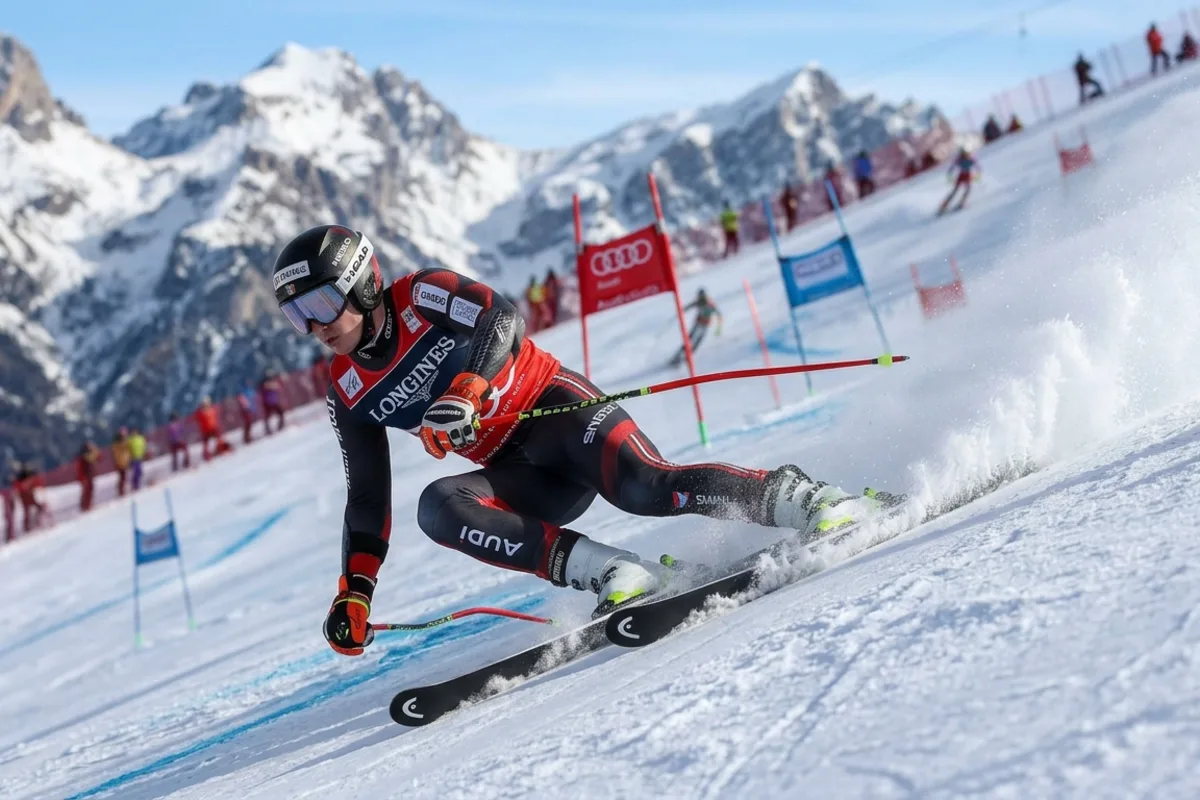
Many aspiring ski racers believe the path to a faster time is paved exclusively with powerful legs. While leg strength is undeniably a huge part of the equation, it’s a common oversimplification. The true source of efficient power transfer, unwavering balance, and razor-sharp edge control originates from a much more central location: the core.
Specifically, the ability to control and resist rotational forces is what allows a skier to maintain a direct line to the finish, channeling every ounce of energy into forward momentum.
This is the difference between fighting the mountain and flowing with it. When an athlete can keep their upper body quiet and stable, facing downhill while their legs and skis carve aggressively beneath them, they are demonstrating a highly developed sense of torso stability.
This article will examine the intricate mechanics behind this skill, identify the specific muscles that make it possible, and provide a framework for developing the strength needed to excel in a competitive environment.
Content
The biomechanics of a quiet upper body
The concept of a “quiet upper body” is a cornerstone of modern ski racing technique. It refers to the skier’s ability to keep their torso, shoulders, and head oriented down the fall line, largely independent of the rapid, powerful movements of the lower body.
This separation of upper and lower body is not a passive state; it is an active, dynamic process of stabilization that requires immense strength and coordination. It’s the visual cue that an athlete is in complete control, dictating their path rather than reacting to the forces generated by the turn.
This control is what allows for a cleaner, more direct, and ultimately faster line through the gates.
Understanding force transmission and absorption
In a high-speed turn, a ski racer generates enormous forces. These forces travel up from the snow, through the skis and boots, and into the athlete’s body. The core acts as a critical junction, a transmission system that must decide what to do with these forces. A weak or unstable core will buckle or twist under the load.
This results in a loss of energy, as the force dissipates through unwanted upper body rotation instead of being directed back into the skis for the next turn. It also disrupts balance, forcing the skier to make constant, inefficient corrections. A strong, stable core, however, can absorb these forces and redirect them effectively.
It acts like a sophisticated suspension system, allowing the legs to move and angulate independently while the upper body remains a stable platform. This efficient transmission is what creates the powerful rebound or “pop” out of a turn, propelling the racer towards the next gate with increased velocity. The energy isn’t lost; it’s recycled.
The principle of counter-rotation
Counter-rotation is the active movement of the upper body in the opposite direction of the lower body’s turn. While some degree of counter-rotation is natural, elite ski racing seeks to minimize it. The goal is to resist the lower body’s turning momentum, not to actively twist against it.
This is where the concept of rotational core stability skiing becomes so important. It’s not about being rigid like a statue; it’s about dynamic control. The core muscles must fire in a precise sequence to create a stable cylinder, preventing the torque generated by the skis from twisting the torso. When a skier enters a turn, the legs and hips rotate into the arc.
An untrained athlete’s upper body will naturally follow, leading to an over-rotated position that makes it difficult to initiate the next turn quickly. The trained athlete uses their core to “un-link” this connection. Their shoulders and hips operate on different planes, a phenomenon known as dissociation.
This allows them to finish one turn and already be in a powerful, aligned position to start the next, effectively shortening the transition phase and carrying more speed through the course.
The impact on balance and edge angle
A stable core is directly linked to a skier’s ability to maintain balance and achieve aggressive edge angles. When the upper body is stable and aligned over the outside ski, the center of mass is in an optimal position. This allows the skier to commit more deeply into the turn, driving the ski’s edge into the snow with greater pressure and confidence. Imagine a spinning top; it is most stable when its axis is perfectly vertical.
Similarly, a skier is most stable when their core provides a solid, predictable axis of rotation. Any unwanted twisting or bending at the waist shifts the center of mass, compromising balance and reducing the amount of pressure that can be applied to the edge. This often leads to the inside ski lifting or the outside ski “chattering” or losing its grip, especially on icy or challenging surfaces.
Athletes who can hold this core stability can push their skis to a higher edge angle, creating a cleaner, more powerful carved turn that generates speed rather than scrubbing it.
The anatomy of a skier’s core
When we talk about the “core,” it’s a much more complex system than just the “six-pack” abdominal muscles (the rectus abdominis). For a ski racer, the core is a three-dimensional cylinder of muscle that includes everything from the hips to the shoulders, encompassing the front, back, and sides of the torso.
These muscles work together not just to create movement but, more importantly, to prevent it. Their primary job on the race course is to provide a rigid structure that can withstand the immense rotational forces generated during a turn. Understanding the specific roles of these muscle groups is the first step toward training them effectively.
The deep stabilizers: Transverse abdominis and multifidus
At the very center of core function are the deep stabilizing muscles, which act like a natural corset for the spine. The transverse abdominis (TVA) is the deepest layer of abdominal muscle, wrapping around the torso from front to back. Its fibers run horizontally, and when it contracts, it cinches the waist and increases intra-abdominal pressure, creating an incredibly stable cylinder around the lumbar spine.
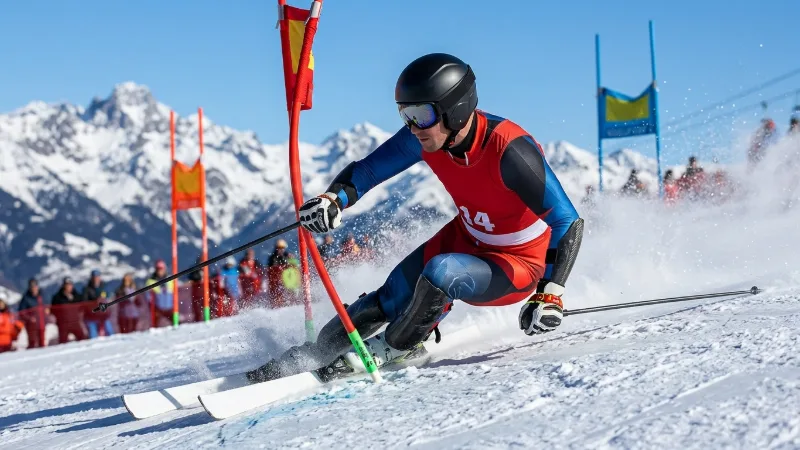
The multifidus is a series of small but powerful muscles that run along the length of the spinal column, connecting individual vertebrae. They provide fine-tuned control and stability from one segment of the spine to the next. In skiing, these muscles are constantly active, firing preemptively before any major movement to brace the spine for impact and rotational stress.
A strong TVA and multifidus are what prevent the lower back from twisting or flexing under load, protecting it from injury and forming the solid foundation upon which all other movements are built. Developing this transverse core strength is a primary goal for any serious racer.
The rotational controllers: Obliques
The internal and external obliques are the powerhouse muscles for controlling rotation. They are located on the sides of the torso and work in opposition to one another. When you make a left turn on skis, your lower body rotates to the left. The natural tendency would be for your upper body to follow.
To prevent this, the right external oblique and the left internal oblique contract together, creating a “braking” force that stops the torso from twisting. This is a classic example of anti-rotation. These muscles are not just working to twist the body; they are working much harder to prevent it from being twisted by external forces.
Their ability to contract isometrically—to generate force without changing length—is what allows a skier to maintain that critical separation between the upper and lower body. The stronger and more responsive the obliques are, the quieter the upper body will be, and the more efficiently power can be transferred from the edge of one turn to the edge of the next.
The supporting cast: Glutes, lats, and erector spinae
No part of the core works in isolation. The system is connected through extensive networks of fascia and muscle. The gluteus medius and maximus are powerful hip stabilizers. They connect the pelvis to the legs and play a major role in preventing the hips from dropping or rotating out of alignment during a turn. A stable pelvis is the base of a stable spine.
Above, the latissimus dorsi (“lats”) are large back muscles that connect the arms and shoulders to the spine and pelvis. They help to keep the shoulders level and prevent the upper body from breaking at the waist.
Finally, the erector spinae group runs vertically along the spine, working with the abdominals to maintain an athletic, forward-leaning posture. This entire sling of muscles, from the glutes up to the lats, works as a single, integrated unit.
A weakness in any one of these supporting muscles can lead to a breakdown in the entire system, forcing compensations that waste energy and increase the risk of injury. This is why a holistic approach to training the complete array of skiing muscle groups is so effective.
Training for rotational control off the snow
Developing the kind of core stability required for elite ski racing doesn’t happen on the slopes alone. It requires a dedicated, year-round strength and conditioning program that specifically targets the unique demands of the sport. The goal of this training is not just to build raw strength, but to improve neuromuscular control—the brain’s ability to activate the right muscles at the right time with the right amount of force.
This is achieved through exercises that challenge the body to resist movement, particularly rotation, from various angles and positions. A well-designed program will progress from basic stabilization to more complex, dynamic movements that mimic the patterns seen on the race course.
Foundational anti-rotation exercises
Before an athlete can control powerful, high-speed movements, they must first learn to resist force from a stable base. This is the purpose of foundational anti-rotation exercises. These movements teach the body to engage the deep core stabilizers and obliques to prevent the spine from twisting.
• Pallof Press: This is a cornerstone exercise. Standing perpendicular to a cable machine or resistance band, hold the handle at chest height with both hands. Press the handle straight out in front of you, resisting the band’s pull to twist your torso. The key is to keep your hips and shoulders perfectly square. This directly trains the obliques and TVA to fire isometrically to prevent rotation.
• Bird-Dog: From a hands-and-knees position, extend the opposite arm and leg simultaneously while keeping the back flat and the hips level. This challenges the body to stabilize against the rotational force created by the unsupported limbs. A common mistake is to arch the back or let the hip drop; the goal is to maintain a perfectly still torso.
• Renegade Row: In a push-up position with hands on dumbbells, perform a row with one arm while stabilizing the body with the other arm and the core. The body will want to rotate open as you lift the weight; the core’s job is to fight that rotation and keep the hips and shoulders parallel to the floor.
These exercises build the initial mind-muscle connection and baseline strength necessary for more advanced training. They are not about moving heavy weight but about perfect form and control.
Dynamic and integrated movements
Once a solid foundation of stability is established, training can progress to more dynamic and integrated movements that better replicate the demands of skiing. These exercises challenge rotational stability while the limbs are in motion, forcing the core to adapt and stabilize in a constantly changing environment.
• Cable Chops and Lifts: These exercises involve moving a cable or band diagonally across the body, from high to low (chop) or low to high (lift). While the arms are moving, the core must work hard to prevent the torso from twisting with the weight. The focus should be on generating the movement from the hips and torso while the arms guide the handle, all while resisting unwanted rotation at the end ranges of motion.
• Landmine Rotations: With one end of a barbell anchored in a landmine attachment (or securely in a corner), hold the other end with both hands and move it from one hip to the other in an arc. The core must work to control the momentum of the bar, decelerating it on one side and re-accelerating it to the other, all while maintaining a stable spine.
• Medicine Ball Rotational Throws: This is a more explosive movement. Standing perpendicular to a solid wall, twist away from the wall and then explosively rotate and throw a medicine ball against it. The key is to “catch” the rebound and control the deceleration force with the core before initiating the next throw. This builds both concentric (force-producing) and eccentric (force-absorbing) strength in the obliques.
These dynamic exercises bridge the gap between the weight room and the ski hill, training the core to function under speed and load.
Periodization and progression in training
A successful training program is not random; it is structured and periodized. This means that the type, volume, and intensity of training change throughout the year to align with the competitive season.
| Training phase | Primary goal | Example core exercises |
| Off-Season (Base Building) | Build foundational strength and muscle mass. Focus on perfect form and higher volume. | Pallof Press (3-4 sets of 10-12 reps), Bird-Dog (3 sets of 15 reps per side), Planks, and Side Planks (building duration). |
| Pre-Season (Power Development) | Convert strength into sport-specific power. Increase intensity and speed of movements. | Landmine Rotations (3-4 sets of 8-10 reps), Medicine Ball Throws (3 sets of 8 reps per side), and Cable Chops (heavier weight, 3 sets of 8-10 reps). |
| In-Season (Maintenance) | Maintain strength and power without creating excessive fatigue. Lower volume, high intensity. | Renegade Rows (2-3 sets of 6-8 reps), Pallof Press (2 sets of 8 reps, high tension), and focused mobility work. |
Progression is also critical within each phase. This can mean increasing the weight, adding more repetitions, reducing rest time, or moving to a more challenging variation of an exercise (e.g., from a standard plank to a plank with an arm or leg lift).
By carefully planning the training cycle, an athlete can ensure they arrive at the start gate of their most important races with their core strength at its peak. This is a principle we apply meticulously in our programs at Ski Zenit, tailoring progression to each athlete’s unique development curve.
Translating gym strength to on-snow performance
Developing powerful and responsive core muscles in the gym is only half the battle. The ultimate goal is to translate that physical capacity into improved technique and faster times on the hill. This requires a conscious effort to connect the feeling of core engagement in the gym with the movements of skiing.
It involves specific on-snow drills, mental cues, and a profound understanding of how a stable torso influences every aspect of a turn, from initiation to completion. It’s the process of turning raw physical potential into refined, efficient, and repeatable skills.
Drills for developing core awareness
On-snow drills are essential for building the neural pathways that allow an athlete to use their core strength automatically and effectively. These drills are designed to isolate specific movements and exaggerate the feeling of core stability, making it easier to replicate in a full-speed race run.
- Pole Drills: One of the most effective drills involves holding the ski poles horizontally in front of the chest with both hands, like handlebars. The goal is to ski a course of stubbies or brushes while keeping the poles pointed directly down the fall line at all times. This provides immediate visual feedback. If the poles swing from side to side, it indicates that the upper body is rotating with the turns. The athlete must actively use their core to resist this rotation and keep the poles stable.
- “Hands Forward” Skiing: A simpler variation is to ski with both hands forward, as if carrying a tray of drinks. The objective is to keep the tray perfectly level and stable throughout the turn. This forces the skier to absorb terrain variations and turning forces through their ankles, knees, and hips, while the core acts as a shock absorber to prevent that energy from disrupting the upper body.
- One-Ski Skiing: Skiing on only the outside ski of the turn is an extreme balance challenge that instantly exposes any core instability. Without the support of the inside ski, the athlete must maintain their center of mass perfectly over the base of support. This requires constant, subtle adjustments from the deep stabilizing muscles of the core to prevent falling to the inside of the turn.
These drills, when practiced consistently, help to hardwire the feeling of a quiet upper body into the athlete’s muscle memory.
Mental cues and focus points
Physical drills are most effective when paired with specific mental cues. These are simple, actionable thoughts that an athlete can use during training or a race to trigger the correct physical response. The best cues are often external rather than internal. Instead of thinking “tighten my abs,” which can lead to rigidity, an athlete might use a cue that focuses on the outcome.
For example, a powerful cue is to imagine a laser beam shooting out from the center of your chest. Your goal is to keep that laser beam pointed directly at the next gate, or even two gates ahead, throughout the entire turn.
This external focus encourages the body to self-organize and use the core muscles to achieve the goal of keeping the chest oriented downhill. Another common cue is to “keep the zipper of your jacket pointed down the fall line.” These simple images can be more effective at producing the desired movement pattern than trying to contract individual muscles consciously in the heat of the moment.
We often work with our athletes to find the personal cues that resonate most strongly with them, as this internal dialogue is a significant part of high-level performance.
Analyzing video to identify rotational issues
Video analysis is an indispensable tool for connecting off-snow training with on-snow results. What an athlete feels they are doing and what they are actually doing can be two very different things. By reviewing video footage with a coach, a skier can get objective feedback on their upper body position.
A coach can draw lines on the screen to show the angle of the shoulders relative to the skis or track the movement of the skier’s core through a series of turns. This visual evidence is incredibly powerful. An athlete might see that while their shoulders start in a good position, they begin to rotate toward the end of the turn, a sign that their core endurance is fatiguing.
Or they might notice a subtle but consistent break at the waist on their weaker side. This detailed feedback allows the training to be highly specific. If video shows a weakness in resisting rotation to the left, the athlete and their strength coach can add specific anti-rotation core exercises that target that exact pattern.
This data-driven approach, a hallmark of our training philosophy at Ski Zenit, ensures that time in the gym is spent as efficiently as possible, directly addressing the technical flaws identified on the snow.
Are you ready to stop fighting the mountain and start dictating your line? Building a truly stable and powerful core is the foundation of modern ski racing. If you’re prepared to refine your technique, understand the intricacies of gate strategy, and receive professional guidance on the training and equipment that will help you find more speed, it may be time to join a dedicated program.
Our competitive skiing camps offer an environment where you can translate strength into skill and unlock your true potential on the course.