
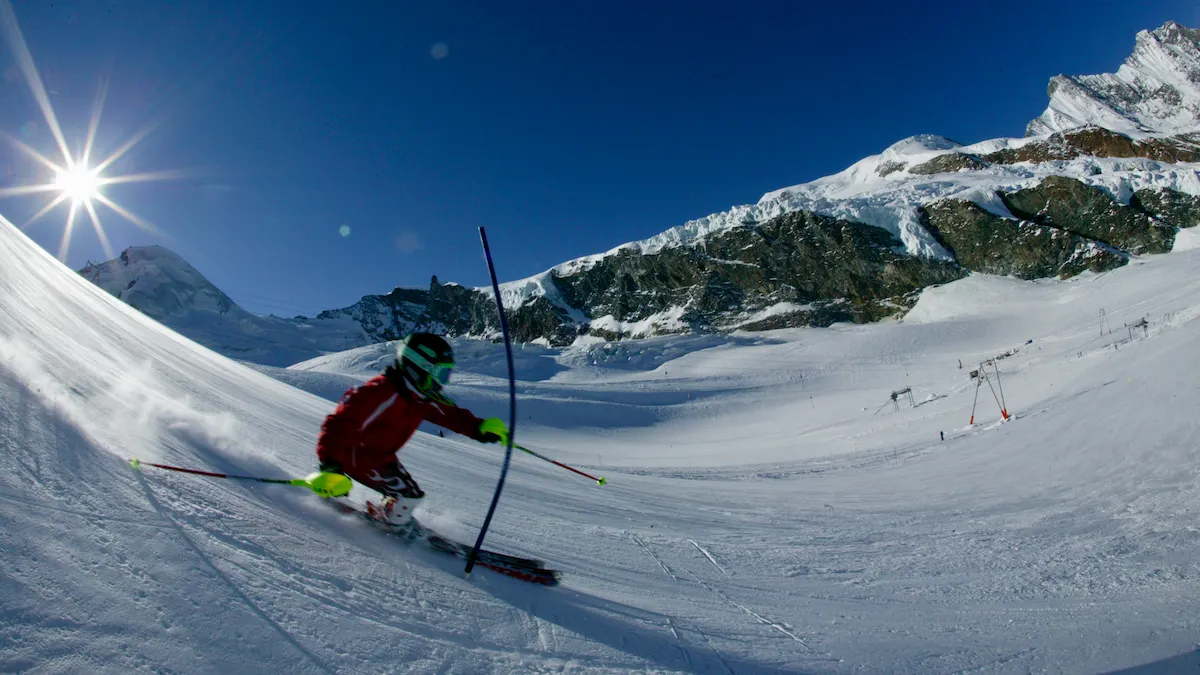
Standing at the top of a giant slalom course involves more than just physical strength and sharp edges. You feel the cold air hitting your face, the weight of your helmet, and the vibration of the mountain under your boots.
While many racers focus solely on their physical warm-up, the most successful athletes know that the race is often won or lost in the mind before they even push off the start wand. Using ski racing visualization techniques allows you to run the course hundreds of times without ever putting a physical strain on your body.
The way your brain processes movement is fascinating. When you vividly picture yourself carving through a specific turn or clearing a gate, your brain fires the same neural pathways that it uses during the actual physical action.
This isn’t just a “feel-good” exercise; it is a way to build muscle memory while you are sitting in a hotel room or riding the chairlift in Zermatt. By the time you actually drop into the course, your body feels like it has already been there, which reduces anxiety and improves your reaction time.
As we look closer at how this works, you will see that mental prep is a skill that requires practice, just like your carved turns. It is not something you do once and forget.
It is a consistent habit that separates those who podium from those who stay in the middle of the pack. Let’s look at how you can start building these mental habits to see real changes in your skiing.
Content
Why mental rehearsal skiing changes your results
The concept of mental rehearsal skiing is about creating a blueprint for your run. When you walk a course during inspection, you are gathering data. You see the offset of the gates, the fall line, and the spots where the snow might be getting icy or rutted.
Mental rehearsal takes that data and turns it into a felt experience. Instead of just remembering where to turn, you are teaching your nervous system how to react to those specific conditions.
Many racers find that their physical performance is limited by their mental speed. If your brain is struggling to process the next gate, your body will naturally slow down to compensate.
By rehearsing the run mentally, you “speed up” your internal processor. You can practice the rhythm of a flush or the transition through a hairpin until it feels automatic. This leaves your conscious mind free to focus on tactics and micro-adjustments during the actual race.
As you might have noticed, the best skiers in the world often look like they are in a trance at the start gate. They are moving their hands, leaning their bodies, and closing their eyes.
They are not just thinking about the run; they are living it. This level of focus helps block out distractions like the crowd, the noise of the announcer, or the pressure of the clock. It puts you in a “flow state” where your training takes over and you perform at your peak without overthinking.
The connection between mind and muscle
Science shows that your muscles actually twitch in tiny, almost invisible ways when you visualize a movement. This phenomenon is why ski racing visualization techniques are so effective. You are essentially giving your muscles a “dry run.”
If you have a habit of sitting back on your skis during a transition, you can use visualization to correct that. You picture yourself driving your shins into the front of your boots and feeling the pressure on your outside ski. Over time, this mental correction starts to show up in your physical skiing.
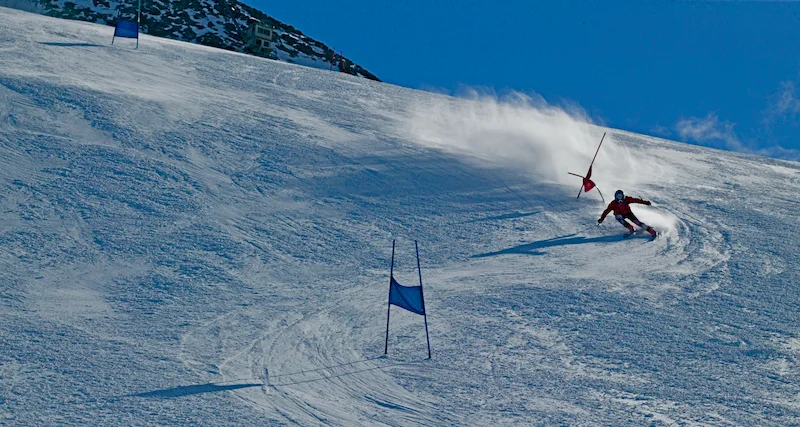
This process also helps with confidence. A lot of the hesitation we feel on steep or icy pitches comes from a fear of the unknown. When you have mentally rehearsed handling a difficult section of the track successfully, that fear starts to fade. You have already “seen” yourself handle the ice and maintain your line. This mental certainty allows you to ski more aggressively and take the lines that lead to faster times.
Creating your own pre-race visualization script
To get the most out of your mental training, it helps to have a structured approach. A pre-race visualization script is a written or mental guide that walks you through your ideal performance.
It should be as detailed as possible. Don’t just think, “I will ski fast.” Instead, focus on the specific sensations and actions that lead to speed. You want to involve all your senses to make the experience feel real to your brain.
Start by finding a quiet place where you won’t be interrupted. You can do this the night before a race or even in the van on the way to the mountain. Close your eyes and start with your breathing.
Once you are relaxed, begin your “script” from the moment you step into the start gate. Feel the grip of your poles, hear the beep of the timer, and see the first few gates stretching out before you.
| Phase of the run | Focus points for visualization | Sensory details to include |
|---|---|---|
| The start | Explosive push, clean exit | The sound of the wand, the snap of your poles |
| Mid-course rhythm | Early edge engagement, high line | The wind against your suit, the “shhh” of the snow |
| Technical sections | Quick feet, stable upper body | The feeling of the gate hitting your guards |
| The finish | Aerodynamic tuck, driving through the line | Seeing the green light on the scoreboard |
As you work through your script, try to keep the timing as close to real life as possible. If the course takes 60 seconds to ski, your visualization should take about 60 seconds.
If you find yourself “teleporting” from the top to the bottom, slow down and fill in the gaps. The more accurate your mental timing, the better your internal clock will be during the actual race. This helps you judge your pace and know when you can push harder or when you need to be more tactical.
Sensory details that make a difference
The difference between a vague thought and a powerful visualization lies in the details. When you are writing or thinking through your pre-race visualization script, try to include things like the temperature of the air, the brightness of the sun on the snow, and the specific smell of the wax on your skis.
These small details act as “anchors” that help your brain believe the experience is happening. The more anchors you have, the more effective the training becomes.
You should also include how you want to feel emotionally. Instead of visualizing anxiety, picture yourself feeling “charged” or “focused.” If you hit a bump in your mental run, don’t stop.
Practice recovering from it. Visualize your ski catching an edge, but then immediately see yourself recovering your balance and staying on line. This teaches you that mistakes aren’t the end of the race and gives you the mental tools to stay calm when things don’t go perfectly on the hill.
How sports hypnosis alpine works for racers
Sometimes, traditional visualization isn’t enough to break through a performance plateau or overcome a specific fear. This is where sports hypnosis alpine techniques can be very useful.
Despite what you might see in movies, sports hypnosis is simply a state of deep, relaxed focus. It allows you to access your subconscious mind, which is where your automatic habits and deep-seated beliefs live. It is a way to “reprogram” your responses to high-pressure situations.
In a state of hypnosis, you are more open to positive suggestions. If you have a habit of “freezing” on steep terrain, a professional can help you replace that “freeze” response with a “flow” response.
You learn to associate the sight of a steep pitch with a feeling of excitement and a technical focus on your outside ski. This happens at a level deeper than just “trying harder.” It becomes a natural part of how you react to the mountain.
As we saw earlier with visualization, the goal is to make the right movements feel automatic. Hypnosis accelerates this process. It can be especially helpful for athletes returning from injury.
Often, the body is healed, but the mind is still trying to protect the injured limb. Hypnosis can help “convince” the brain that the body is strong and capable again, allowing the athlete to return to their previous level of performance without the mental baggage of the injury.
Practical steps to use these methods daily
You don’t need a lot of extra time to work on your ski racing visualization techniques. It is more about finding small windows throughout your day. For example, you can spend five minutes before you get out of bed in the morning running through your technical goals for the day.
While you are on the chairlift between training laps, you can close your eyes for 30 seconds and rehearse the specific turn you are working on with your coach.
Consistency is what makes these tools work. If you only try to visualize once a month, it won’t have much of an impact. But if you do it every day, you are constantly reinforcing those positive neural pathways.
You can even use visualization off the snow. During the summer months when you are in the gym, you can visualize your ski runs while you are on the stationary bike or doing squats. This keeps your “skiing brain” active even when you are far from the glaciers of Saas-Fee.
Another great way to use these techniques is through video analysis. Watch footage of yourself or your favorite World Cup racers. As you watch, try to “feel” the turns in your own body.
If you see a racer with a perfect transition, close your eyes and try to mimic that feeling in your mind. This helps you internalize good technique and gives you a clear mental image to aim for during your own training sessions.
Handling distractions and staying focused
One of the biggest challenges in ski racing is the environment. There is a lot going on at a race—people talking, music playing, and the pressure of competition. Your mental training should include these factors.
Don’t just visualize a perfect, quiet run. Occasionally, visualize yourself performing well even when there is noise or when the weather is bad. This builds “mental toughness.”
If you find your mind wandering during your mental rehearsal skiing, don’t get frustrated. Simply acknowledge the thought and gently bring your focus back to the course. This is actually part of the training.
The ability to refocus after a distraction is precisely what you need when you are mid-course and something unexpected happens. Every time you bring your attention back, you are strengthening your “focus muscle.”
Comparing different mental training tools
It can be helpful to see how different techniques compare so you can decide which ones to prioritize in your training. While all of these methods are valuable, they serve slightly different purposes depending on your goals and your current level of experience.
| Technique | Primary Goal | Best time to use | Difficulty level |
|---|---|---|---|
| Basic Visualization | Improve technical form | Daily / On the chairlift | Beginner |
| Pre-race Scripting | Prepare for a specific course | The night before/ Morning of | Intermediate |
| Sports Hypnosis | Overcome deep blocks or fears | Off-season / Weekly sessions | Advanced |
| Video Modeling | Learn new movement patterns | Evening review/ Rest days | Beginner |
As you can see, there is a tool for every situation. Most athletes start with basic visualization and then gradually move into more detailed scripts as they get better at course inspection.
The key is to start where you are and be patient with the process. You wouldn’t expect to ski like a pro after one day on the hill, and you shouldn’t expect your mental game to be perfect right away either.
Working on these skills often feels less like “work” than a heavy leg session in the gym, but the results can be just as impactful. When you combine physical fitness, technical skill, and mental clarity, you become a much more formidable competitor. You start to see the course differently, and the gates that used to seem intimidating now look like opportunities to gain time.
As you move forward with your training, remember that the mind is just another part of your equipment. You wouldn’t go to a race with dull edges or a broken binding, so don’t go with an unprepared mind.
Taking the time to work on your ski racing visualization techniques gives you an edge that goes beyond what you can find in a wax room. It gives you the ability to stay calm, stay focused, and ski at your absolute best when it matters most.
Whether you are training on the steep slopes of Chile during the summer or preparing for a winter season in the Swiss Alps, these mental habits will travel with you. They don’t require extra luggage or special permits; they only require your commitment and a few minutes of your time. Over time, you will find that the mental scripts you create become the reality you live on the racecourse.
Are you ready to take your competitive skiing to the next level? Join our competitive skiing program, perfect your technique, master gate technique and track strategy, or visit the competitive skiing camp for professional training and advice on the equipment that will help you win.