
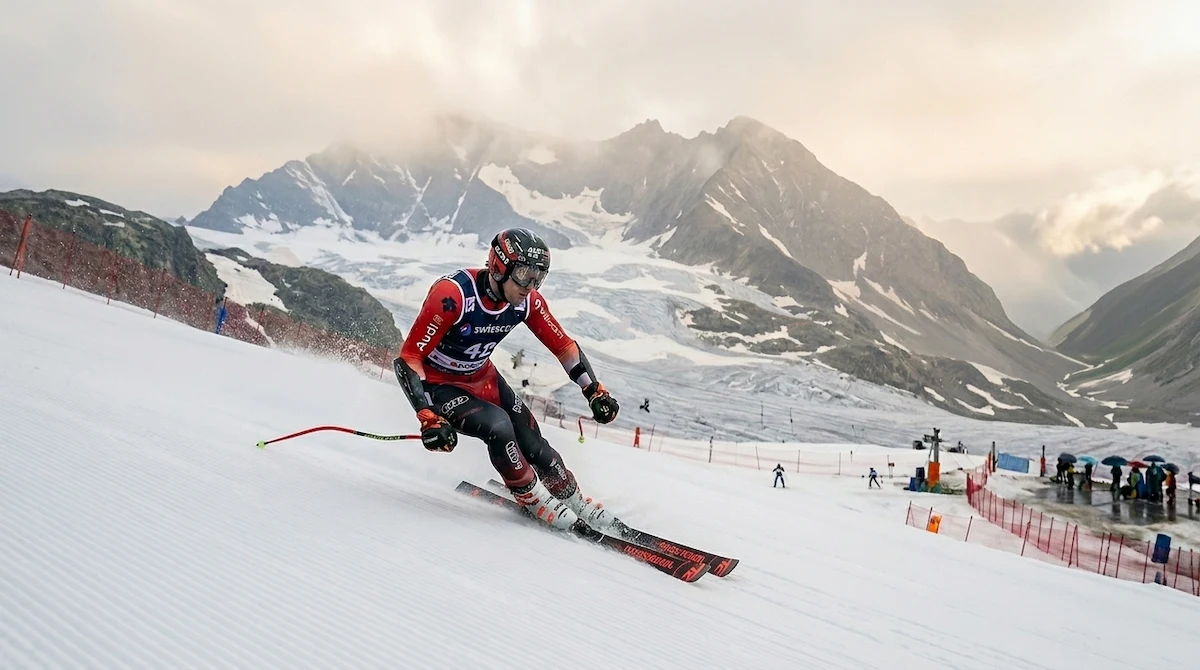
Skiing often brings to mind bright blue skies and crisp, cold air reflecting off fresh powder. However, the reality of mountain life, especially during shoulder seasons or on glaciers like Zermatt and Saas-Fee, sometimes involves liquid precipitation.
When clouds roll in and the temperature hovers just above freezing, many recreational skiers head for the lodge. For those of us dedicated to the sport, particularly in the competitive racing world, these moments offer a unique opportunity.
You might find yourself standing at the top of a course, feeling the dampness on your shoulders, and asking: Can you ski in the rain? The short answer is yes, and doing so can actually turn you into a much more versatile athlete.
Rainy days on the mountain change the texture of the snow and the way your equipment interacts with the surface. Instead of the dry, squeaky snow of mid-winter, you encounter a heavy, high-moisture environment.
This requires a shift in mindset and a few technical adjustments. At Ski Zenit, we see these days as a chance to separate the dedicated racers from the casual tourists. Handling these conditions builds a level of balance and sensitivity that you simply cannot develop on perfect corduroy.
When the moisture levels rise, the snow becomes more “grabby” or creates a suction effect on the base of your skis. Understanding how to manage this friction is a key part of elite race training.
While it might seem less than ideal, some of the most memorable training sessions happen when the weather is less than perfect. It forces you to focus on your tactile connection with the snow. You learn to feel the edge engagement through a softer, more variable surface.
This experience is invaluable when you find yourself in a race where the bottom of the course is slushy while the top is icy. We see this often in late-season races or during summer training on the glaciers of Switzerland and Chile. Being prepared for anything means you never let the weather dictate your performance.
Content
Technical adjustments for wet snow performance
When the rain starts to fall, the physical properties of the snowpack undergo a rapid transformation. The water fills the spaces between the snow crystals, increasing the density and weight of the surface. This creates a much higher degree of surface tension.
As your skis slide over this wet surface, a thin film of water can actually create a vacuum, pulling back on your base and slowing you down. This is the opposite of what happens in very cold snow, where the friction is caused by the dry crystals scratching the base.
Managing friction and suction
To combat the suction effect of wet snow, you need to think about the structure of your ski bases. High-performance racing skis often have a “structure” or a pattern ground into the base. In wet conditions, a deeper, more aggressive structure helps break the surface tension by allowing air to move between the ski and the water.
If you are using a fine structure meant for cold, dry snow, you will feel like you are skiing through glue. This is where professional equipment advice becomes a game-changer. Adjusting your tuning to match the moisture content of the day can save seconds on the clock.
Beyond the physical structure, your choice of wax is paramount. Hydrophobic waxes, typically in the warm temperature range like yellow or red, are designed to repel water molecules. These waxes contain additives that prevent the water from sticking to the base.
During our camps, we often discuss how a simple change in the morning’s prep can change the entire feel of the afternoon session. Even if the rain is light, the high humidity in the air and the moisture in the snow will affect your glide.
Adjusting your stance and balance
The way you stand on your skis needs to adapt to the heavier snow. Wet snow is much more punishing if you are caught too far back or too far forward. Because the snow is denser, it offers more resistance to your shins and the front of your skis.
If you are leaning back, the skis will want to “track” away from you, and the heavy snow will make it very difficult to pull them back under your center of mass. You need to stay extremely centered and active through your core.
In these conditions, we focus on a more gradual pressure application. Instead of a sharp, aggressive edge bite, you want to feel the edge sink into the moisture-rich surface and then build pressure smoothly.
If you try to force a turn in heavy, wet snow, the snow can “collapse” under the ski, leading to a loss of grip. Think of it as being more fluid and patient with your turns. This technical refinement is a major part of our race technique programs, as it teaches athletes how to find grip where others find only slush.
Visibility and optical challenges
One of the hardest parts of skiing in the rain isn’t the snow itself, but seeing where you are going. Raindrops on your goggles can distort your vision, and the flat light that usually accompanies rain makes it hard to see bumps or changes in terrain.
Choosing the right lens color is a technical necessity. Lenses in the rose, yellow, or light blue spectrum are designed to enhance contrast in low-light settings. They help you see the “texture” of the wet snow, which is vital for safety and speed.
We often recommend using a specialized water-repellent spray on the outside of the goggle lens. This helps the water bead up and roll off rather than smearing. Additionally, keeping your goggles clear of fog is a constant battle in high humidity. The key is to keep moving to maintain airflow and avoid putting your goggles on top of a wet helmet or forehead, which introduces moisture into the foam.
Essential gear for wet weather training
Staying dry is not just about comfort; it is about performance. Once you get wet, your body spends a massive amount of amount of energy trying to stay warm, which takes away from your focus and muscle power. High-quality outerwear is the first line of defense.
We look for technical shells with high waterproof ratings, usually 20,000mm or higher. These garments are designed to keep liquid water out while still allowing sweat vapor to escape, which is essential during high-intensity gate training.
Layering for high humidity
In the rain, your layering strategy changes. You want to avoid cotton at all costs, as it absorbs water and stays cold. Synthetic or merino wool base layers are the standard. In wet conditions, we often suggest a thinner mid-layer than you would wear on a dry day of the same temperature.
This is because the humidity makes the air feel “heavy,” and you can easily overheat under a waterproof shell. Overheating leads to sweating, and once you are wet from the inside out, the day becomes much more difficult.
A common trick we use at our camps is the use of a “rain cape” or a specialized racing poncho. These are worn over your race suit or shell and are designed to be completely waterproof. They are often clear or brightly colored and allow you to stay dry while waiting in the start gate. For athletes focusing on race technique, keeping the muscles warm and dry between runs is the difference between a productive session and a wasted day.
Protecting your extremities
Gloves are usually the first thing to fail in the rain. Once the leather or fabric saturates, your hands get cold almost instantly. We recommend having at least two pairs of high-quality racing gloves. Keep one pair inside your jacket or in a dry bag for the second half of the training session. Some athletes prefer using thin over-gloves or “shells” that go over their racing mitts to provide an extra layer of waterproofing.
Your boots also need attention. While ski boots are made of plastic, water can seep in through the buckles or the tongue area. Using “boot gloves” or neoprene covers can help keep the moisture out and the heat in. It is these small details that allow professional athletes to stay on the hill for six hours while others leave after two. At Ski Zenit, we emphasize that being a pro means being prepared for the environment, no matter what it looks like.
Post-ski equipment care
The work doesn’t end when you click out of your bindings. Rainwater is surprisingly hard on ski equipment. The moisture can lead to rusted edges overnight if not handled correctly. After a rainy session, you must dry your skis thoroughly with a cloth. Don’t just leave them in the bag; take them out, wipe them down, and let them air dry in a room with good circulation.
The same applies to your boots. Remove the liners to ensure the shells are dry inside. Using a boot dryer is highly recommended to prevent odors and to make sure you aren’t putting your feet into damp boots the next morning. Taking care of your gear ensures that your investment lasts and that your performance remains consistent. We often include gear maintenance as part of our specialized clinics because it is a fundamental part of the sport.
Training philosophy in challenging conditions
Training in the rain is a mental game as much as a physical one. It tests your resolve and your passion for the sport. At Ski Zenit, we believe that elite athletes are forged in the most difficult environments. If you only train when the sun is shining, you are only preparing for half of the possible race scenarios. Many World Cup races are held in pouring rain or heavy sleet. If that is the first time you are experiencing those conditions, you are already at a disadvantage.
Building mental toughness
There is a certain psychological edge you gain when you know you can perform in any weather. When you see your competitors complaining about the rain, you can smile knowing you have trained for this. This resilience is a core value we instill in our junior and professional athletes. It’s about reframing the situation: the rain isn’t an obstacle; it’s a specialized training tool.
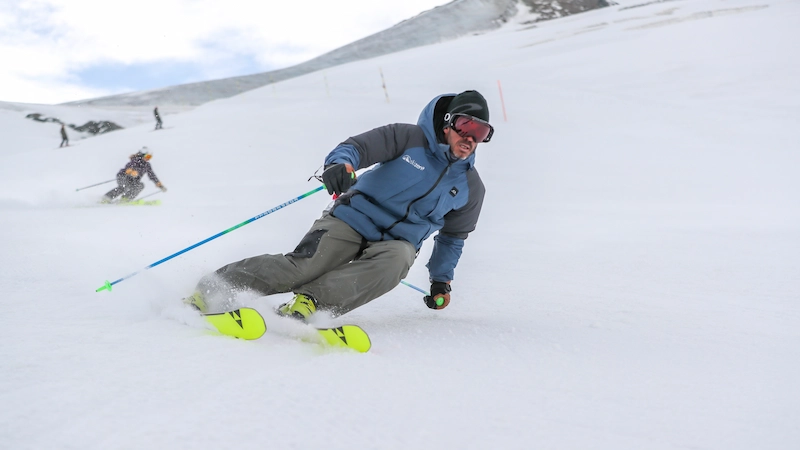
Can you ski in the rain and still have fun? Absolutely. It requires a sense of humor and a focus on the process rather than the outcome. When the conditions are tough, we often shift our goals from “perfect times” to “perfect movements.” We look for stability, clean edge releases, and the ability to adapt to changing snow mid-turn. These are the skills that win races on the long term.
Safety considerations on wet slopes
Safety is always the priority. Rain can make the snow very fast in some places and very slow in others, which can be a dangerous combination if you aren’t prepared. It can also hide “death cookies” (frozen chunks of snow) or create deep ruts more quickly than dry snow. Our coaches are experts at reading the mountain and adjusting the course set to ensure safety.
We also pay close attention to the risk of lightning. While rare in the high mountains during winter, spring rain can sometimes be accompanied by thunderstorms. If there is any electrical activity, we clear the mountain immediately. Part of being a professional is knowing when to push and when to step back. We teach our athletes to respect the mountain and its power, which is a lesson that serves them well throughout their careers.
The science of snow and water
To truly master wet weather skiing, it helps to understand what is happening under your feet at a molecular level. Snow is a porous material. When it rains, the water fills these pores through a process called infiltration. Initially, this can actually make the snow surface faster and harder as the water acts as a lubricant. However, as the snow becomes saturated, it reaches a “slush” state where the structural integrity of the snow crystals is lost.
Understanding snow saturation
There is a tipping point where wet snow goes from being “fast and firm” to “slow and heavy.” This depends on the temperature of the snowpack versus the temperature of the rain. If the snowpack is very cold (well below freezing), the rain might freeze on contact, creating a glaze of ice.
This is common on glaciers and requires very sharp edges and a precise technical approach. If the snowpack is already near freezing, the rain will melt the bonds between crystals, leading to that heavy, “mashed potato” consistency.
Learning to identify these stages allows a racer to anticipate how the ski will react. In the early stages of rain, you can often ski quite aggressively. As the saturation increases, you need to lighten your touch and focus on staying “above” the snow rather than digging deep into it. This level of snow-reading is something we emphasize in our professional and Masters programs.
The role of salt in race prep
In the competitive world, we often use salt to manage wet snow. When it rains on a race course, organizers will spread ammonium nitrate or common salt on the surface. This chemically reacts with the wet snow to harden it, creating a firm, icy surface even in the rain. This is a fascinating aspect of the sport that many people don’t see.
Training on “salted” snow is a specific skill. The surface becomes very “glassy” and consistent, which is great for racing but requires a specific edge tune. We often provide advice on how to prep skis for salted conditions, as it differs from natural ice. Understanding these nuances is part of the elite access we provide at Ski Zenit, giving our athletes the same knowledge base as World Cup technicians.
Environmental impact and mountain management
Rain at high altitudes is also a point of study for mountain managers. It affects how the snow stays on the slopes and the longevity of the ski season. In places like Saas-Fee and Zermatt, the glaciers are carefully managed to handle these weather events. As athletes and coaches, we are guests on these mountains, and we learn to appreciate the work that goes into maintaining the slopes even when the weather isn’t cooperating.
We encourage our athletes to be students of the mountain. Understanding how rain affects the snowpack isn’t just about the next run; it’s about developing a deep connection with the environment where they compete. This knowledge builds a more well-rounded athlete who is capable of making informed decisions about their training and safety.
Maximizing your time on the mountain
The reality of competitive skiing is that the weather is rarely perfect. The athletes who reach the top are those who can adapt, thrive, and maintain their focus regardless of what is falling from the sky. At Ski Zenit, we pride ourselves on providing the environment and the expertise to help you navigate these challenges.
Whether it is through specialized equipment advice, technical coaching, or mental preparation, we ensure that every day on the mountain is a step toward your goals.
Can you ski in the rain and still make progress? Not only can you make progress, but you might find that these are the days where you learn the most about your skiing. The tactile feedback from wet snow is a powerful teacher. It strips away the ease of perfect conditions and forces you to rely on your core technique and balance. This is where true mastery begins.
Our year-round programs are designed to handle everything the mountains of Switzerland and Chile can throw at us. From the high-altitude glaciers where rain can turn to snow in minutes, to the spring sessions where the sun and rain play tag, we are always prepared. We provide the elite training access that private athletes need to bridge the gap between “good” and “exceptional.”
As we move through the season, remember that your equipment, your technique, and your mindset are all parts of a single system. When one part is challenged by the environment, the others must step up. Rainy days are the ultimate test of that system. By embracing the dampness, the heavy snow, and the flat light, you are building a foundation of resilience that will serve you in every race you ever enter.
The journey to becoming an elite skier is paved with all kinds of weather. Those who embrace the full spectrum of the mountain experience are the ones who truly understand the sport. We are here to guide you through every turn, every gate, and every storm.
Our commitment to excellence means we provide the best possible training, no matter the conditions, ensuring that you are always ready for the next challenge.