
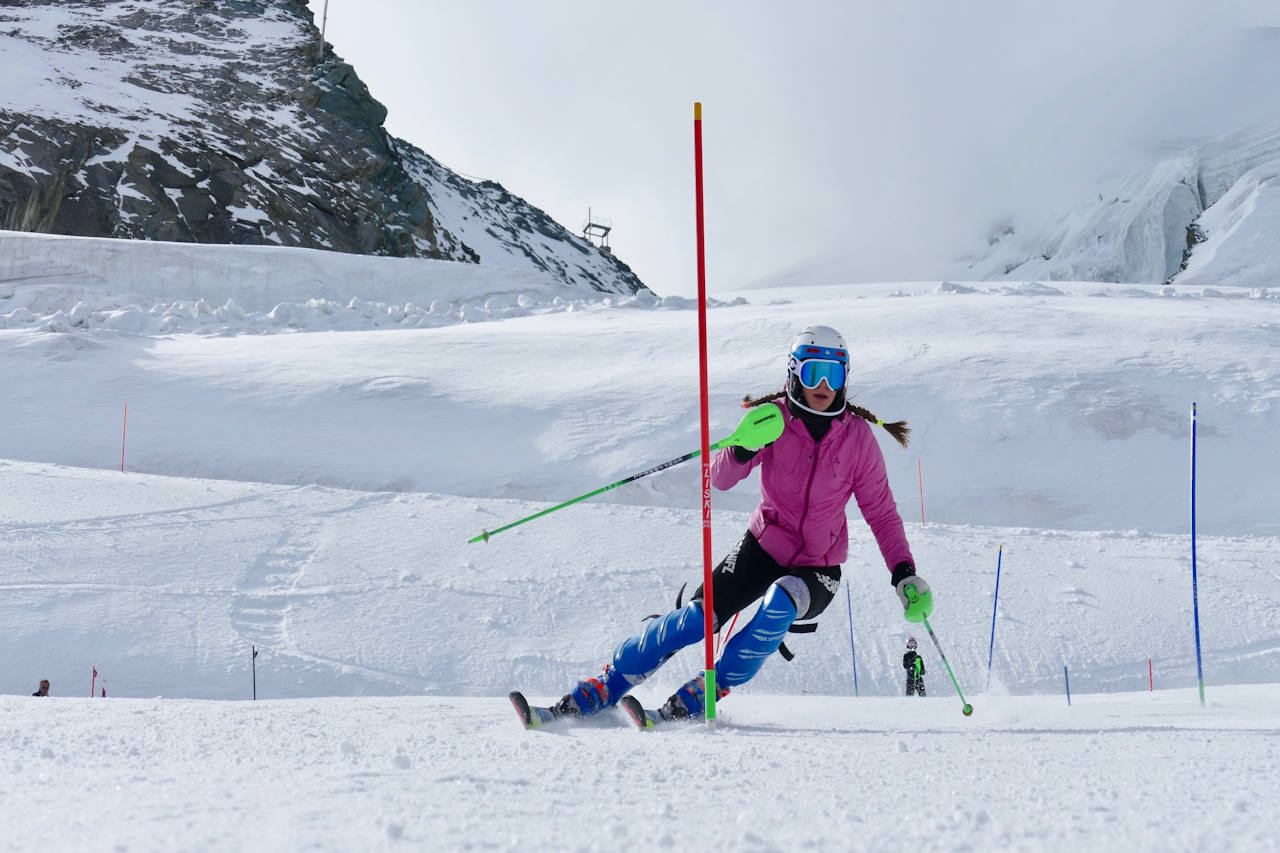
Skiing represents a unique blend of grace, power, and environmental awareness. Many people standing at the base of a mountain look up at the white peaks of Zermatt or Saas-Fee and wonder about the challenge ahead.
You might see a four-year-old gliding effortlessly down a blue run and think it looks simple. Then, you see a World Cup racer leaning into a turn at sixty miles per hour, and the perspective shifts.
This contrast brings us to a common question for many aspiring athletes: is skiing hard or easy? The answer depends entirely on your goals and the level of precision you want to achieve.
At Ski Zenit, we see athletes from every corner of the globe. Some arrive with years of experience, while others are just starting their journey into the competitive world. The initial sensation of sliding on snow is often more intuitive than people expect.
Modern equipment has made the entry point much more accessible than it was thirty years ago. However, as you move away from casual recreation and start to look at the clock, the sport changes. We provide access to Swiss elite training for private athletes because we know that the right guidance transforms a difficult challenge into a structured progression.
Living and training in Switzerland provides a specific advantage. The terrain here is varied and demanding. When you spend your days on the glaciers, you learn to respect the nuances of the snow. You notice how the texture changes from the crisp, icy morning to the softer, sun-touched afternoon.
This environment is the best classroom for anyone looking to understand the mechanics of motion on snow. Whether you are a teenager aiming for the national team or an adult masters skier looking to shave a second off your personal best, the mountain always has something to teach.
Content
The learning curve from first turns to the race course
Starting your journey on the snow usually involves a few days of finding your balance. You learn how to stand over your boots and how to use your edges to control your speed. For most people, the first few days involve a lot of trial and error.
You find that your center of gravity needs to be much further forward than your instincts suggest. Once you find that sweet spot, the mountain starts to feel like a playground rather than an obstacle.
The transition to intermediate terrain
After you move past the basic snowplow, you begin to explore parallel turns. This is where the real fun begins. You start to feel the skis work for you. Instead of pushing against the snow to slow down, you begin to use the sidecut of the ski to carve across the hill.
This phase is vital because it builds the muscle memory needed for more advanced maneuvers. You start to understand how your ankles, knees, and hips work together to create a fluid motion.
In our programs, we emphasize the importance of this middle ground. It is easy to get stuck in a plateau where you feel comfortable but stop improving. We push our athletes to move beyond their comfort zones in a safe and controlled way.
By introducing varied terrain and different snow conditions, we ensure that your skills are versatile. A great skier isn’t just someone who can look good on a groomed run; it is someone who can handle ice, slush, and steep pitches with the same level of confidence.
Technical foundations for speed
When we talk about high-level performance, the conversation shifts toward efficiency. Every movement you make on the skis should have a purpose. If you move your arms too much, you lose balance. If you sit back, you lose control of your tips. We focus on the quiet upper body and the active lower body. This separation is what allows the best athletes to stay stable while their legs are working through complex terrain at high speeds.
We often use video analysis to show athletes exactly what they are doing. Sometimes, what you feel on the snow is very different from what is actually happening. Seeing yourself on screen helps bridge that gap.
You might think you are leaning into the turn, but the video shows you are breaking at the waist. Correcting these small technical errors is how we help you reach the next level. It is a process of constant refinement and attention to detail.
The role of specialized equipment
Your gear is your connection to the snow. For a beginner, a soft boot and a short ski are helpful because they are forgiving. They allow you to make mistakes without immediate consequences. However, as you progress, that same equipment will start to hold you back.
You need the stability of a stiffer boot and the edge grip of a well-tuned race ski. We provide expert advice on equipment because we know it can make a massive difference in your performance.
Choosing the right radius for your skis or the correct flex for your boots is a science. It depends on your weight, your strength, and your specific goals. If you are focusing on Slalom, you need a quick, responsive ski. If you are looking at Super-G, you need something that can handle high-speed vibrations. We help our athletes navigate these choices so they can step into the start gate with total confidence in their setup.
The jump into competitive skiing
Once you have a solid foundation, you might feel the pull of the race course. There is something incredibly rewarding about seeing your name on a scoreboard and knowing you gave everything to a run. But this is also where the sport becomes significantly more technical.
Is ski racing hard or easy? If you are just sliding through the gates for fun, it is relatively straightforward. If you want to win, it requires a level of dedication and physical fitness that few other sports demand.
Developing gate technique and track strategy
Racing isn’t just about skiing fast; it is about finding the fastest line through a set of obstacles. You have to learn how to read the course. Every gate setter has a different rhythm, and you need to anticipate the turns before you reach them.
This is where track strategy becomes essential. You need to know where to take risks and where to be tactical. Sometimes, the fastest way down isn’t a straight line; it is a line that allows you to carry the most speed into the next section.
We spend a lot of time on gate technique. This involves learning how to clear the gates without losing your balance or your line. It also involves understanding the physics of the turn.
You want to complete your turn above the gate so that you are already accelerating as you pass it. This “early pressure” is a hallmark of elite racers. It takes thousands of repetitions to make this feel natural, which is why our year-round programs are so effective.
Physical conditioning for athletes
You cannot be a great ski racer if you aren’t an athlete off the hill. The forces involved in a high-speed turn are immense. Your legs need the strength to hold an edge against several times your body weight. Your core needs to be rock solid to maintain your position. We incorporate dryland training into our camps because we know that a fit body is less prone to injury and more capable of handling the demands of the sport.
This conditioning isn’t just about lifting weights. It is about balance, agility, and explosive power. We use a variety of exercises to mimic the movements you make on the snow. From plyometrics to balance boards, every session is designed to make you a more capable skier.
We also talk about recovery and nutrition. At the elite level, how you treat your body between training sessions is just as important as what you do on the mountain.
The mental game of racing
Standing in the start gate can be an intense experience. The wind is blowing, the clock is ticking, and everyone is watching. Learning how to manage those nerves is a huge part of the sport. We teach our athletes visualization techniques and pre-race routines. If you can see the run in your head before you take the first step, you are much more likely to execute it well.
Confidence comes from preparation. When you know you have done the work, the pressure becomes a motivator rather than a distraction. We foster a supportive environment where athletes can learn from their mistakes. Every crash or missed gate is an opportunity to learn something new. By maintaining a positive and professional mindset, our athletes are able to perform at their best when it matters most.
Elite training environments and programs
To reach the top, you need to train where the best train. Switzerland offers some of the most consistent and challenging conditions in the world. Our base in the Valais region gives us access to high-altitude glaciers that allow for training even in the middle of the summer. This year-round access is a game-changer for serious athletes who don’t want to lose their “snow feel” during the off-season.
Summer and autumn on the glaciers
While most people are thinking about the beach, our athletes are heading to Zermatt and Saas-Fee. The summer glacier camps provide a unique atmosphere. The snow is firm in the morning, providing a perfect surface for technical drills.
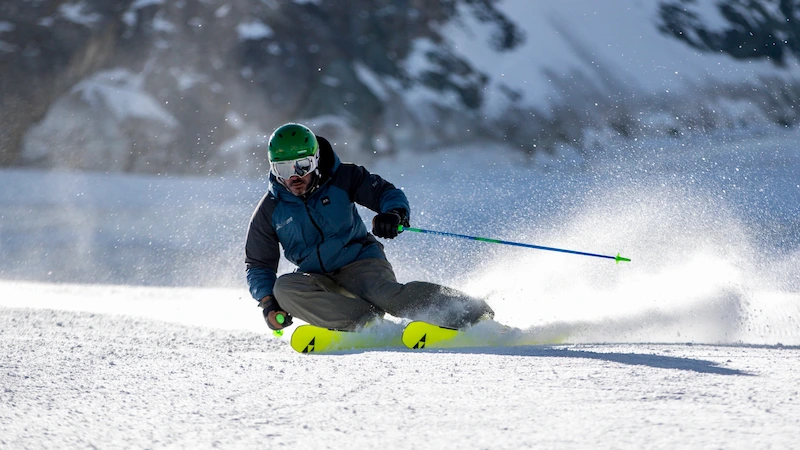
As the sun gets higher, the conditions change, allowing us to work on different aspects of skiing. These camps are often where the biggest technical breakthroughs happen because there is less pressure than during the winter race season.
Training in the summer also allows for a more relaxed pace. We can spend more time on video review and individual feedback. It is a time for experimentation and building new habits.
By the time the winter arrives, our athletes are already in top form, while others are just starting to get their ski legs back. This head start is often what separates the podium finishers from the rest of the pack.
The Chilean experience
For those looking for a true winter experience during the Northern Hemisphere’s summer, we head to Chile. The mountains in South America offer a completely different feel. The terrain is vast, and the snow quality is world-class. It is a chance to escape the glacier environment and ski on full-length winter runs. This variety is essential for developing a well-rounded skill set.
Our trips to Chile are more than just training camps; they are adventures. Athletes learn to adapt to new environments and different cultures. This resilience is a valuable trait for any competitor.
Whether we are training on the steep faces of the Andes or enjoying the local hospitality, the focus remains on excellence. We bring the same professional Swiss standards to our international programs, ensuring that every athlete gets the most out of their time on the snow.
Dedicated programs for all ages
We believe that elite training should be accessible to everyone. Our junior programs focus on building a love for the sport while instilling the discipline needed for racing. For teenagers, we provide a more intensive environment that prepares them for FIS-level competition.
We also have a very strong Adult Masters program. These athletes are some of the most dedicated people we know. They bring a wealth of experience and a passion for improvement that is truly inspiring.
Every age group has different needs. Younger children need more variety and play-based learning to keep them engaged. Adolescents need a balance of technical instruction and physical challenge. Adults often need to unlearn old habits and focus on efficiency to protect their joints while still skiing fast. Our coaches are experts at tailoring their approach to the individual, ensuring that everyone at Ski Zenit makes progress.
The technical nuances of modern ski racing
The sport has evolved rapidly over the last decade. The equipment is more specialized, and the techniques have become more athletic. To stay competitive, you have to stay informed about these changes. We are constantly updating our methods to reflect the latest trends in the professional world. This commitment to staying current is why so many athletes trust us with their development.
The mechanics of the carved turn
In modern racing, skidding is the enemy of speed. Every time your skis slide sideways, you lose momentum. The goal is to keep the skis on their edges as much as possible. This requires a precise combination of balance and pressure. You have to move your center of mass inside the turn while keeping enough weight on the outside ski to maintain grip. It is a delicate balancing act that happens in a fraction of a second.
As we saw earlier, the equipment plays a big role here. A modern race ski is designed to bend into a specific arc when it is tipped on edge and pressured. Your job as a skier is to provide that pressure at the right moment. We work on the timing of the “extension” and “retraction” phases of the turn. By mastering these movements, you can actually generate speed out of the turn, catapulting yourself toward the next gate.
Understanding snow physics
Different types of snow require different techniques. On hard, injected ice, you need a very aggressive edge angle and perfect balance. If you are too far back, your skis will wash out. On softer snow, you need a more subtle touch. If you push too hard, your skis will dig in and slow you down. Learning how to “feel” the snow through your boots is one of the most advanced skills a skier can develop.
We talk to our athletes about the “temperature” of their skiing. Sometimes you need to be “hot” and aggressive, and other times you need to be “cool” and smooth. This adaptability is what makes a champion.
By training in the diverse conditions of Switzerland and Chile, our athletes become experts at reading the surface and adjusting their technique accordingly. It is this level of detail that makes the difference in a sport where races are won and lost by hundredths of a second.
The evolution of race lines
The line that racers take has changed as the equipment has improved. In the past, skiers took a much wider line to compensate for skis that didn’t turn as sharply. Today, the line is much tighter and more direct. This requires faster reactions and more strength. You have to be able to handle the high G-forces that come with making a sharp turn at high speed.
We use timing systems and video overlays to help athletes find the optimal line. Sometimes, taking a slightly longer path that allows for more speed is faster than taking the shortest possible route. We analyze these trade-offs in detail. The basics are easy, but obviously, like any high-level sport, it becomes very demanding as you progress in the sport. This is especially true when you are trying to find those final few tenths of a second on a race course.
Professional race camps and their benefits
Joining a dedicated race camp is the fastest way to improve. When you are surrounded by other motivated athletes and coached by experts, your progress accelerates. There is a collective energy in a camp that you just don’t get when training on your own. You push each other, learn from each other, and celebrate each other’s successes.
- Daily video analysis to identify and correct technical flaws.
- Access to professional-grade timing equipment for real-time feedback.
- Expert ski tuning and equipment advice from experienced coaches.
- Structured physical conditioning sessions designed for skiers.
- Mental coaching to help with race-day nerves and focus.
These camps are not just about what happens on the snow. We also spend time in the “tuning room,” teaching athletes how to take care of their equipment. Knowing how to sharpen your edges and wax your bases is an essential part of being a racer. It gives you a deeper connection to your gear and ensures that you are always competing on the best possible surface.
The importance of consistency
Skiing is a sport of muscle memory. You can’t expect to reach an elite level if you only ski for one week a year. Consistency is the key to long-term success. This is why we offer year-round programs. By keeping the momentum going throughout the year, you ensure that your skills continue to evolve. Even a few days on the snow every month can make a huge difference in your development.
We also encourage our athletes to stay active in other sports. Cycling, tennis, and soccer are all great for developing the lateral strength and coordination needed for skiing. A well-rounded athlete is a better skier. We take a holistic approach to training, looking at every aspect of an athlete’s life to see where we can make improvements. This comprehensive strategy is what leads to sustainable high performance.
The Ski Zenit philosophy
Our approach is built on respect, expertise, and a passion for the mountains. We treat every athlete as an individual, recognizing that everyone has different strengths and weaknesses. Our goal is to help you reach your full potential, whatever that may be. We pride ourselves on being approachable and friendly, creating an environment where athletes feel comfortable taking risks and pushing their limits.
We are also committed to being at the forefront of the sport. We are always looking for new ways to improve our coaching and our programs. Whether it is using the latest sensor technology to track an athlete’s movements or exploring new training locations, we never stop looking for an edge. This drive for excellence is what defines Ski Zenit and what we pass on to everyone who trains with us.
The path forward in your skiing career
The journey from a casual skier to a competitive racer is one of the most challenging and rewarding paths you can take. It requires dedication, resilience, and a willingness to learn.
But the feeling of standing at the top of a mountain, knowing you have the skills and the preparation to take on any challenge, is incomparable. Whether you are looking to shave seconds off your time or simply want to experience the thrill of the race course, there is a place for you in this sport.
As you have noticed in this article, we believe that the right environment and the right coaching are the keys to success. By training in places like Zermatt and Saas-Fee, and by focusing on the technical details that matter, you can reach levels you never thought possible. The mountain is waiting, and the clock is ready to start. Every turn you make is an opportunity to get better, to get faster, and to find your true potential on the snow.
We invite you to join us in the Swiss Alps or on the slopes of Chile. Experience the difference that professional, elite-level training can make. Our community of athletes and coaches is dedicated to excellence, and we would love to have you be a part of it. The world of ski racing is a small, passionate community, and there is nothing quite like the bond formed through hard work and shared goals in the mountains.
Our programs are designed to be flexible and accessible, catering to the needs of modern athletes and their families. We understand the demands of school, work, and travel, and we work with you to create a training schedule that fits your life. At the end of the day, our goal is to see you succeed and to see you enjoy the sport as much as we do. The mountains have given us so much, and we are honored to share that passion with the next generation of racers.
Focus on racing and you will find that the rewards go far beyond the scoreboard. You will develop a level of discipline and focus that will serve you well in all areas of your life. You will make lifelong friends and create memories that will last a lifetime. The challenge is real, but so is the satisfaction of overcoming it. We are here to guide you every step of the way, providing the expertise and the support you need to shine.
Are you ready to take your competitive skiing to the next level? Join our competitive skiing program, perfect your technique, master gate technique and track strategy, or visit the competitive skiing camp for professional training and advice on the equipment that will help you win.