
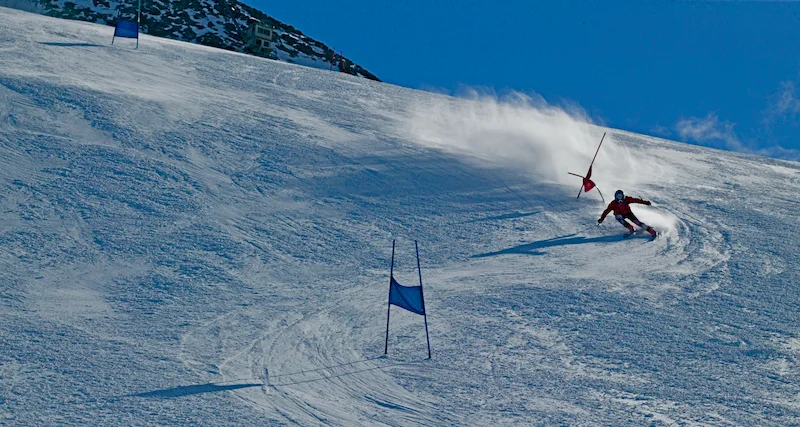
Maintaining an athletic position on skis is the foundation of every successful turn, regardless of the slope’s steepness or the snow’s consistency. When you watch elite racers on the World Cup circuit, their ability to stay balanced over the center of their skis looks effortless, but it is the result of thousands of hours of intentional practice.
Many skiers struggle with staying too far back, a habit often called being in the backseat, which limits control and increases the risk of injury. Addressing these alignment issues requires a clear understanding of how your body interacts with gravity and the forces generated during a high-speed turn.
The relationship between your boots, bindings, and the snow surface determines how much power you can transfer to your edges. If your weight is slightly behind the center point, the tips of your skis lose contact pressure, making it difficult to initiate a turn or maintain a line.
This often leads to a cycle where the skier tries to force the turn with their upper body, which only further destabilizes their stance. By focusing on technical skiing posture correction, you can ensure that every movement you make is efficient and contributes to your speed rather than fighting against it.
As we look closer at the mechanics of skiing, it becomes clear that balance is not a static state but a dynamic process. You are constantly adjusting to changes in terrain, snow texture, and centrifugal force.
To stay ahead of these variables, your posture must be proactive. This means having a tensioned core, flexed ankles, and a slight forward lean that allows you to drive the ski from the front.
Throughout this article, we will look at the specific ways you can identify and fix common stance errors to become a more capable and confident athlete on the mountain.
Content
The physics of central balance alpine positioning
To understand why a neutral stance is so effective, we have to look at the physics of a ski. Modern skis are designed with a sidecut and a specific mounting point for bindings.
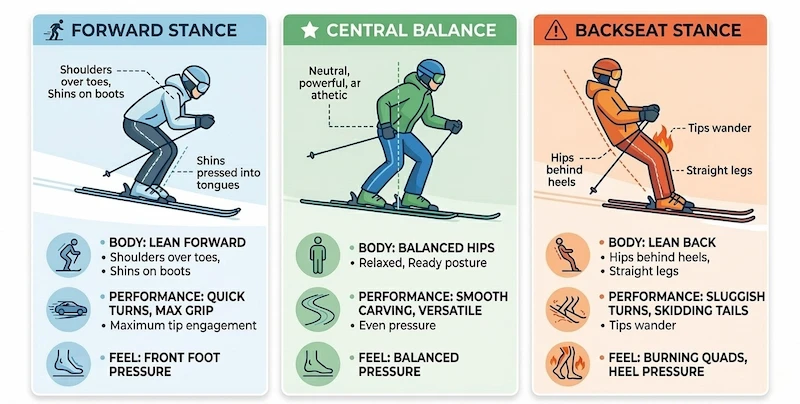
This mounting point is calculated to be the spot where the skier’s weight is distributed evenly across the running surface of the ski. When you achieve a central balance alpine position, you allow the ski to work as the engineers intended. The pressure is distributed from the tip to the tail, allowing the sidecut to engage the snow and create a clean, carved arc.
When you move out of this central zone, the performance of the ski changes immediately. If you are too far forward, the tips might “hook” or dive into the snow, which can be dangerous at high speeds. However, the most common issue is being too far back.
In this position, the tail of the ski is overloaded, and the tip becomes light. You might notice that your skis chatter or that you have to “slur” your turns instead of carving them.
This is because the ski cannot find its edge without the proper leverage from the front of the boot. You can see this clearly when watching beginners who sit back out of fear, but even seasoned professionals can fall into this habit when they get tired or face challenging conditions.
The center of mass should ideally stay over the middle of the feet. This doesn’t mean you stay perfectly upright; it means your joints—ankles, knees, and hips—are flexed in a way that keeps your weight centered over the base of support.
As you move through different phases of a turn, your center of mass will move laterally and vertically, but it should always return to that central “home” position. Maintaining this requires constant ankle tension.
Your shins should always feel a firm pressure against the tongues of your boots. This pressure is the primary way you communicate with your skis and direct them where to go.
A helpful way to visualize this is to think about your skeletal alignment. When your bones are stacked correctly, your muscles don’t have to work as hard to keep you upright. If you are in the backseat, your quadriceps have to fire constantly to keep you from falling over.
This leads to rapid fatigue and “burning legs” halfway down a run. By correcting your posture, you move the load onto your skeletal system and your larger muscle groups like the glutes and core, which are much more resilient. This efficiency is what allows elite athletes to maintain high-intensity training sessions for hours on end.
Identifying the causes of backseat skiing
Before you can fix a problem, you need to know why it is happening. Correcting backseat skiing starts with a self-diagnosis of your current habits. There are usually three main reasons why a skier ends up behind the center of their skis: technical errors, physical limitations, or equipment issues.
Often, it is a combination of all three. Technical errors usually stem from a lack of understanding of how to initiate a turn. Many people try to start a turn by pushing their feet away from them, which naturally pushes their hips back. Instead, a turn should start with a forward and lateral move of the center of mass.
Physical limitations can also play a huge role. If you have limited dorsiflexion in your ankles—meaning you can’t pull your toes toward your shins very far—you will find it physically impossible to get forward in a ski boot.
This lack of mobility forces the rest of your body to compensate, usually by sticking your butt out or leaning back. Similarly, a weak core makes it difficult to hold a strong, forward-leaning torso.
Without a stable midsection, your upper body will flop around, making it much harder to keep your weight over your toes. Strengthening these areas off the snow is just as important as the work you do on the mountain.
Equipment is the third piece of the puzzle. If your boots are too stiff for your weight or skill level, you won’t be able to flex them forward. This keeps you standing too upright or pushes you into the backseat.
Conversely, if your boots are too soft, they won’t provide the support you need to drive the skis. The ramp angle of your bindings and the “delta” (the height difference between the heel and the toe) also affect your natural stance.
If your heels are too low, you will naturally sit back. Many racers use “zeppa” or boot board adjustments to fine-tune this angle so they can find their natural balance point without fighting their gear.
As you may have noticed in this article, the theme of “intentionality” is everywhere. You cannot fix a posture issue by just skiing more miles; you have to ski better miles. You need to be aware of where your weight is at every moment.
Are you feeling the bottom of your feet? Is the pressure on your heels, your arches, or the balls of your feet? In a perfectly carved turn, you should feel the pressure move from the ball of the foot at initiation toward the arch in the middle of the arc. If you feel it on your heels at any point other than the very end of the turn, you are likely in the backseat.
The forward stance skiing drill for daily practice
To break old habits, you need to introduce new sensations to your muscle memory. A very effective forward stance skiing drill is the “thousand steps” exercise. While skiing down a moderate, groomed slope, try to take as many tiny steps as possible from one ski to the other.
To do this successfully, you have to be perfectly balanced over the center of your skis. If you are too far back, your tips will lift off the snow when you try to step, and you will lose your balance. This drill forces you to find that “sweet spot” where you can move your feet independently of your upper body.
Another great exercise is the “pole drag.” Hold your poles by the middle of the shaft and drag the baskets on the snow next to your boots as you ski. To keep the poles touching the snow, you have to keep your hands forward and your chest down.
This naturally pulls your center of mass forward. If you sit back, your hands will move up and away from the snow, and the poles will lose contact. It is a simple but powerful feedback loop. You can do this on almost any terrain, and it serves as a constant reminder to stay “over the front” of your equipment.
The “shins on tongues” drill is also a staple in competitive training. The goal is to maintain constant, unbreakable contact between your shins and the front of your boots throughout the entire run.
You can even try to “over-flex” at the start of each turn to feel the tips of the skis engage immediately. As we saw earlier, the boots are your steering wheel. If you aren’t touching the steering wheel, you aren’t in control.
This drill helps build the ankle tension necessary for high-level technical skiing. It might feel exaggerated at first, but that exaggeration is often what is needed to overcome years of sitting back.
For more advanced athletes, the “javelin turn” is an excellent way to test balance. In this drill, you lift the inside ski and cross it over the outside ski, pointing the tip of the lifted ski toward the snow.
This forces all of your weight onto the outside ski and requires a very precise forward and central position. If you are even slightly in the backseat, the lifted ski will feel heavy and awkward, and you will likely fall toward the inside of the turn. Mastering this drill ensures that you have the stability and posture needed to handle the high-force environment of a race course.
Anatomy of a turn: moving with the forces
A ski turn can be divided into three phases: initiation, apex, and completion. Your posture needs to adapt to each of these phases while maintaining a central core. In the initiation phase, you are moving your weight from the old outside ski to the new one.
This is the most critical time for technical skiing posture correction. You must move your hips forward and “down the hill.” This movement is often scary for people because it feels like you are falling, but that “fall” is what creates the energy for the turn. By moving forward, you engage the tips of the skis and start the carving process early.
Once you reach the apex—the point where your skis are pointing directly down the fall line—the centrifugal forces are at their highest. Here, you need to be strong and “stacked.”
Your outside leg should be long but not locked, and your inside knee should be tucked in to allow for a high edge angle. Your upper body should be facing slightly more down the hill than your skis, a concept known as separation.
This separation allows your legs to move through a large range of motion while your torso remains a stable platform. If your upper body follows your skis, you lose the ability to make quick adjustments and often end up leaning back as the turn finishes.
In the completion phase, the goal is to transition the energy from the finished turn into the start of the next one. This is where many skiers get “trapped” in the backseat. As the skis come across the hill, the pressure builds up in the tails.
If you don’t actively move your hips forward to “catch up” with your skis, you will start the next turn from behind. Think of it like a game of tag where your hips are always trying to stay ahead of your feet.
This proactive movement is what separates elite racers from recreational skiers. It keeps the momentum flowing down the mountain instead of letting it dissipate out the sides of the turns.
We’ll look at this in more detail later when we discuss race strategy, but it’s worth noting that this “forward move” is even more important in gates. In Slalom or Giant Slalom, the turn must happen exactly where the gate is. If you are late or back, you will miss your line and lose time.
The discipline of posture is what allows a racer to stay on a tight, aggressive line. It gives them the confidence to attack the course because they know their skis will react instantly to their input. This level of precision is only possible when the athlete is perfectly centered over their gear.
The role of core strength and flexibility
While drills on the snow are vital, your off-snow conditioning determines your “ceiling” as an athlete. You cannot maintain a perfect skiing posture if your body isn’t strong enough to hold it. Core stability is the most important physical attribute for a skier.
Your core is the bridge between your upper and lower body. When you are carving a turn at 40 miles per hour, your legs are under immense pressure. Without a strong core, that pressure will cause your upper body to collapse, which inevitably leads to a backseat position. Exercises like planks, dead bugs, and Russian twists are great for building the kind of rotational and anti-rotational strength you need.
Flexibility is the other side of the coin. We already mentioned ankle mobility, but hip flexibility is just as important. Skiing requires your legs to move independently of your pelvis. If your hips are tight, your whole pelvis will tilt when you try to edge your skis, which can throw your balance off.
A regular stretching or yoga routine focusing on the hip flexors, glutes, and hamstrings will make it much easier to achieve the deep, athletic stances required for high-performance skiing. It also helps prevent injuries by allowing your body to absorb unexpected bumps or jolts without snapping.
Proprioception, or your body’s awareness of its position in space, is another skill you can train. Using balance boards, BOSU balls, or even just standing on one leg while brushing your teeth can improve the neural pathways that control balance.
The faster your brain can process where your weight is, the faster it can send signals to your muscles to make corrections. This is why many professional ski camps include “dryland” training that looks more like circus gymnastics than traditional weightlifting. They are training the nervous system to be as responsive as possible.
As you can see, becoming a better skier involves more than just skiing. It is a holistic approach that combines technical knowledge, physical fitness, and mental focus. When you combine these elements, the “backseat” habit starts to disappear naturally.
You won’t have to think about getting forward because your body will have the strength and the habit to stay there. This is the point where skiing becomes truly fun—when you are no longer fighting the mountain but dancing with it.
Equipment tuning for better alignment
Even the best technique can be hindered by poorly set up equipment. If you are serious about correcting backseat skiing, you should visit a professional boot fitter. They can check your “cuff alignment” to ensure that your legs are centered in the boots.
Many people have legs that are slightly bowed or knock-kneed, and if the boot isn’t adjusted to match, it will be impossible to stand flat on the skis. A boot fitter can also add “shims” under your heel or toe to change your ramp angle, which can help “nudge” your posture into a more forward position.
The flex of your boot is another critical factor. Boots are rated by a flex index, usually ranging from 60 for beginners to 150 or more for World Cup racers. If your boot is too stiff, you won’t be able to bend your ankles, which is the “key” to getting forward.
If you can’t flex the boot in the shop at room temperature, you definitely won’t be able to do it on a cold mountain. On the other hand, if you are a powerful athlete and your boot is too soft, you will “over-flex” it, which can also lead to instability. Finding the right balance is essential for technical success.
Don’t forget about your skis. A dull edge or a base that isn’t flat can make the ski feel “darty” or “slippery.” When you don’t trust your edges, your instinct is to move away from the snow—which means leaning back.
Keeping your skis tuned with a consistent edge bevel (usually 1 degree on the base and 2 or 3 degrees on the side for racing) will give you the grip you need to stay committed to your forward stance. When the ski bites into the ice reliably, you feel much more comfortable driving your weight into the front of the boot.
Finally, consider the length and radius of your skis. If you are on skis that are too long for your strength level, they will “drive” you instead of you driving them. This often results in the skier being pulled into the backseat as the ski completes its turn.
For technical training, a shorter “slalom-style” ski is often better because it responds faster and provides more immediate feedback on your posture. Once you have perfected your stance on a shorter ski, you can more easily carry those skills over to longer Giant Slalom or Super-G skis.
Mental focus and the “forward” mindset
Skiing is as much a mental game as a physical one. The backseat position is often a physical manifestation of a “defensive” mindset. When we are scared or uncertain, we naturally want to pull away from the danger. In skiing, the “danger” is the steep slope and the speed.
By leaning back, we feel like we are putting more distance between ourselves and the fall line. However, this is an illusion. Leaning back actually makes you less safe because you lose control of your steering. To fix your posture, you have to adopt an “offensive” mindset.
An offensive mindset means looking ahead. Instead of looking at your ski tips, you should be looking two or three turns down the hill. This opens up your peripheral vision and allows your brain to plan your movements in advance.
When you look down at your feet, you are reacting to what is happening right now, which usually means you are already too late. By looking ahead, you can anticipate changes in terrain and move your center of mass forward to meet them. This simple change in focus can have a profound effect on your physical alignment.
Visualizing your turns before you drop in is another powerful tool. Before you start your run, take a moment to see yourself skiing with a perfect, forward stance. Imagine the feeling of the wind on your chest and the pressure on your shins.
This mental rehearsal “primes” your muscles for the movements they are about to perform. Many elite athletes use this technique to stay calm and focused before a race. It helps turn a complex technical task into a simple, repeatable feeling.
As you may have noticed in this article, the physical and mental aspects of skiing are deeply intertwined. You cannot have one without the other. A strong body gives you the confidence to have an offensive mindset, and an offensive mindset allows you to use your body to its full potential.
This synergy is what creates the “flow state” that skiers spend their whole lives chasing. When everything clicks, the skis feel like an extension of your body, and the mountain feels like a playground rather than a challenge.
Advanced considerations for competitive athletes
For those involved in racing, technical skiing posture correction becomes even more nuanced. In Slalom, the turns are incredibly rapid, requiring a very active and “quick” center of mass.
You don’t have time for big movements, so your posture must be very compact and efficient. In Giant Slalom, the turns are longer and the speeds are higher, which means the forces are much greater. Here, the “stack” is everything. You need to be able to resist hundreds of pounds of force without your hips dropping back or your inside shoulder dipping.
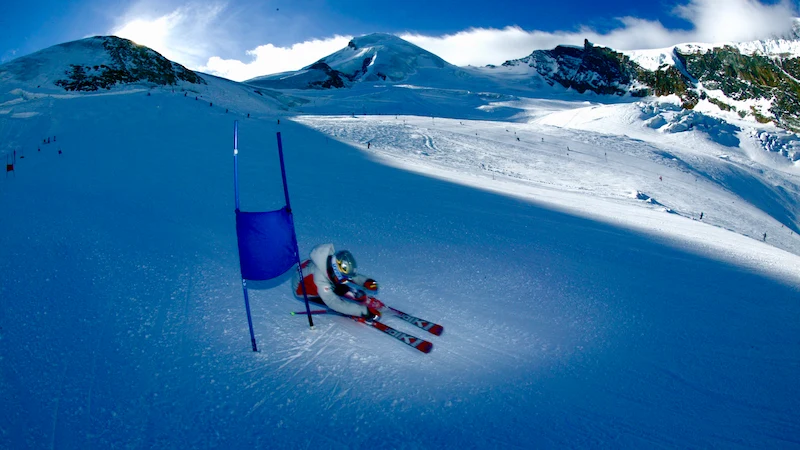
Track strategy also plays a role in your posture. If you are skiing a “tight” line close to the gates, you have to be very precise with your weight distribution. If you are even a few inches too far back, you will “scrub” speed or go wide of the next gate.
Coaches often use video analysis to show athletes exactly where their balance is at every gate. Seeing yourself in slow motion can be a real “lightbulb” moment. You might think you are forward, but the video shows your hips are six inches behind your heels. This visual feedback is one of the fastest ways to make lasting changes.
We’ll look at this in more detail later, but it’s also important to consider how your posture changes in different snow conditions. On hard, injected race ice, your balance has to be perfect. There is no room for error. On softer snow or in “hero dirt” (perfectly groomed, grippy snow), you can get away with a bit more, but the goal should always be the same.
Training on different types of snow—from the glaciers of Switzerland to the slopes of Chile—helps you build a “versatile” posture that can handle anything the mountain throws at you.
The best athletes are the ones who are never satisfied with their technique. They are constantly looking for that extra one percent of efficiency. This might mean trying a new forward stance skiing drill, adjusting their boot setup, or spending more time in the gym. This commitment to excellence is what defines the culture at elite training programs. It’s not just about skiing fast; it’s about skiing well. And skiing well always starts with your posture.
| Discipline | Primary posture focus | Common posture error | Key drill |
|---|---|---|---|
| Slalom | Quick ankle flex, quiet upper body | Upper body rotation | Short-radius “thousand steps” |
| Giant Slalom | Strong “stack,” lateral hip drive | Hips dropping inside/back | Long-radius “javelin turns” |
| Super-G / DH | Aerodynamic tuck, low center of gravity | Standing up too high in bumps | Tuck-to-turn transitions |
Correcting backseat skiing in various terrains
While most technical training happens on groomed runs, your posture needs to hold up in “off-piste” conditions as well. In moguls, for example, being in the backseat is a recipe for disaster. The bumps will buck you around, and you will quickly lose control.
To ski moguls well, you have to be “reaching” forward with your feet and your poles, almost like you are trying to pull yourself down the hill. Your knees and ankles act as shock absorbers, but they can only do that if your weight is centered. If you are back, your legs are “locked,” and the bumps will send all that energy straight into your spine.
In powder, the sensation is a bit different, but the principle is the same. Many people think they need to lean back to keep their tips from sinking. While you do want a slightly more “rear-weighted” distribution compared to ice, you still need to stay centered over the skis.
If you lean too far back, you lose the ability to steer, and your legs will tire out in minutes. Instead, use a “planning” technique where your speed keeps the skis on top of the snow, and your central balance allows you to make subtle weight shifts to turn. Correcting your stance in deep snow is often about finding a “neutral” point rather than a “forward” point.
Steep terrain also tests your posture. When the slope drops away, the natural human reaction is to lean back toward the mountain. But to get your edges to grip on a steep pitch, you have to do the opposite: you have to lean out over the “void.”
This moves your weight onto the downhill ski and allows the edge to bite. If you lean into the hill, your skis will slide out from under you. This is a classic example of how technical skiing posture correction is often counterintuitive. You have to train your brain to move toward the thing it is afraid of.
As you move through these different terrains, you will start to see that “good posture” is a universal language. Whether you are in a race course, a mogul field, or a powder bowl, the laws of physics don’t change.
Your body needs to be balanced, your core needs to be strong, and your mind needs to be focused. By practicing these skills in various environments, you become a more “complete” skier. You won’t just be a “groomer skier” or a “powder skier”; you will be an athlete who can handle anything.
Improving your technique is a journey that never truly ends. Even the best skiers in the world spend their summers analyzing video and working on their stance. It is the most fundamental part of the sport, and getting it right opens up a whole new world of speed and control.
By focusing on the drills and concepts we’ve discussed, you are taking the first steps toward a more professional and efficient way of skiing. Remember to be patient with yourself; breaking old habits takes time, but the reward of a perfectly carved turn is worth every minute of effort.
As you spend more time on the snow, you will start to feel the difference. You’ll notice that you are less tired at the end of the day, that your skis respond more quickly to your movements, and that you have more confidence on steep or icy terrain.
This is the power of technical skiing posture correction. It’s not just about looking good; it’s about having the mechanical advantage to ski the way you’ve always wanted to. Keep pushing your limits, stay curious about your technique, and constantly look for ways to improve.
The mountains are a place of constant learning and growth. Whether you are training for your first race or your hundredth, the basics always matter. Posture, balance, and intent are the tools that will help you reach your goals.
We’ve seen how the body, the mind, and the equipment all work together to create a high-performance athlete. Now, it’s up to you to take this information and put it into practice on the slopes. Every run is an opportunity to get a little bit better, a little bit faster, and a little bit more centered.
Are you ready to take your competitive skiing to the next level? Join our competitive skiing program, perfect your technique, master gate technique and track strategy, or visit the competitive skiing camp for professional training and advice on the equipment that will help you win.
We are here to support your journey every step of the way, providing the expert guidance and elite environment you need to succeed. Let’s get to work and show the world what you are capable of on the snow.