
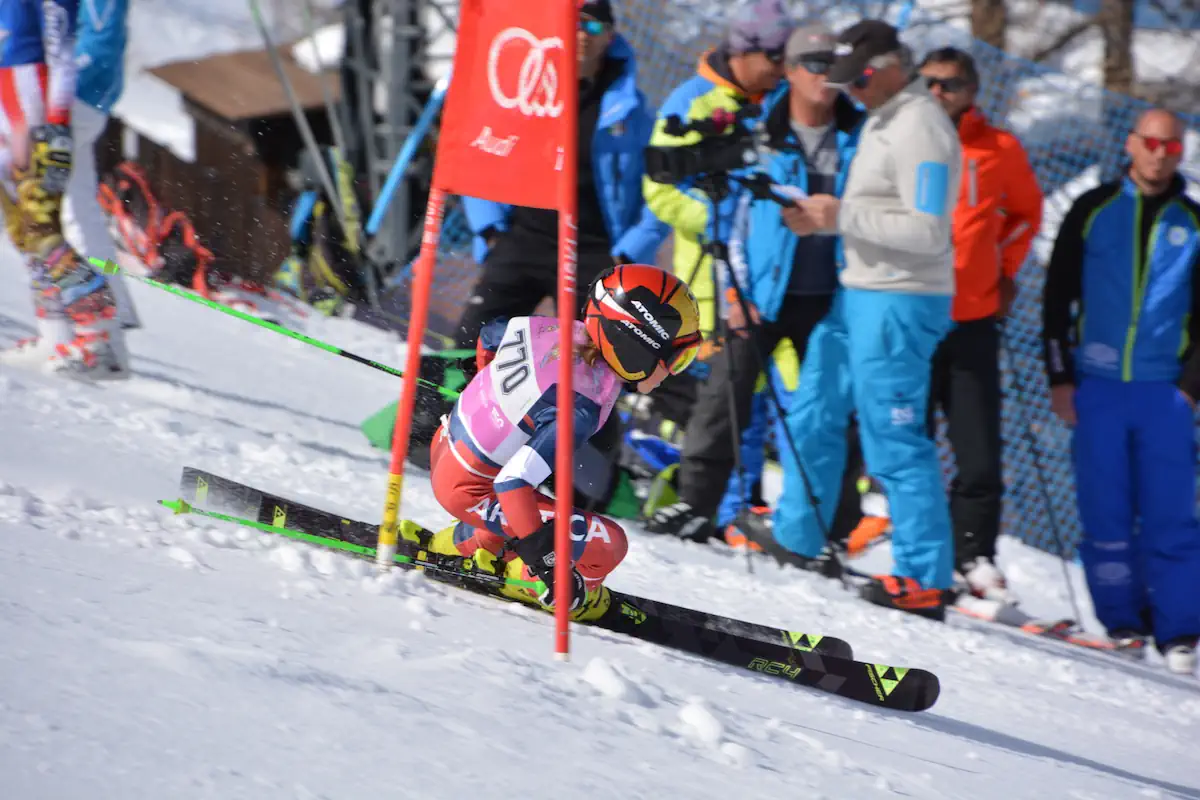
Every ski racer knows the feeling: standing in the start gate, heart pounding, the course stretching out below, looking fast and unforgiving. That rush of adrenaline is exactly what you train for, but sometimes, that energy turns into paralyzing fear or overthinking.
If you are serious about your performance, whether you are a young athlete aiming for the national team or a dedicated masters racer chasing personal bests, managing that pre-race stress is just as important as perfecting your tuck or carving angle.
We work with athletes of all ages and nationalities, from the glaciers of Zermatt and Saas-Fee to the courses in Chile, and we see firsthand how much mental preparation separates good racers from great ones.
The physical training gets you ready, but the mental game helps you execute under pressure. Let’s look at how you can transform those race day nerves into focused energy, effectively overcoming race day anxiety skiing.
Your body’s reaction on race day
Anxiety isn’t just a mental state; it’s a physical response designed to protect you. When you face a high-stakes situation—like a ski race—your body pumps out stress hormones. This is often called the “fight or flight” response. For a ski racer, this translates into muscle tension, rapid breathing, and a narrowing of focus.
The challenge isn’t eliminating this reaction; it’s learning how to redirect it. We want to take that raw energy and channel it into precise, powerful movements.
The difference between excitement and fear
When you feel those butterflies in your stomach, how do you label them? Do you say, “I’m terrified I’m going to miss a gate,” or do you say, “I’m excited to push my limits”?
The physiological response to high excitement and high anxiety is nearly identical. The difference lies entirely in your interpretation. If you view the physical symptoms (fast heart rate, slightly shaky hands) as signs that your body is energized and ready to perform, you shift the narrative from fear to anticipation. This simple cognitive shift is powerful for overcoming race day anxiety skiing.
Physical signs of anxiety and how they impact skiing
Anxiety often shows up in very specific ways that hurt your performance on the snow. You might find yourself gripping your poles too tightly, or your quads might feel heavy and unresponsive.
- Tight grip on poles: A firm grip on your hands or poles causes forearms to fatigue faster, leading to an inability to use the poles effectively for timing or balance. To address this, perform conscious relaxation exercises during your warm-up, specifically focusing on keeping your wrist movements loose.
- Shallow and rapid breathing: This type of breathing results in reduced oxygen delivery to the muscles, a sensation of exhaustion halfway through the run, and difficulty maintaining concentration. The recommended solution is to implement structured breathing exercises, such as box breathing, right before the start.
- Muscle tension (quads and shoulders): Tension in these areas results in an inability to absorb the terrain effectively, causes stiffness in your turns, and leads to a loss of agility and responsiveness. You can alleviate this by performing quick body scans before the race, shaking out your limbs, and focusing on fluid movement during the course inspection.
- Narrow vision (tunnel vision): Tunnel vision causes you to miss key terrain features or gate combinations, leading to late reactions to changes in snow conditions. To solve this, practice looking 3 to 5 gates ahead and utilize your peripheral vision during visualization.
If you recognize these physical signs, you know exactly where to start your mental preparation. The goal is to loosen up the body so the mind can stay sharp.
The 90-minute window: what to do before the start
Consistency is the enemy of anxiety. When everything around you feels chaotic—changing snow conditions, delayed starts, or unfamiliar slopes—having a predictable routine gives you a sense of control. This routine should start long before you click into your bindings at the start gate.
The 90 minutes leading up to your race run are critical for performance readiness. This isn’t the time for high-intensity physical work; this is the time to stabilize your energy and focus.
- Fueling and hydration (90-60 minutes out): Ensure your energy stores are topped up. Dehydration exacerbates anxiety symptoms.
- Physical warm-up (60-30 minutes out): A dynamic warm-up that gets the blood moving without exhausting you. Focus on mobility and activation exercises, specifically targeting the muscle groups you need for powerful skiing (hips, core).
- Course inspection (timing varies): This is where you finalize your plan. Don’t rush. Pay attention to the snow texture and key transitions. If you find yourself getting anxious during inspection, remind yourself that planning reduces uncertainty, which is a key step in overcoming race day anxiety skiing.
- Mental check-in (30 minutes to start): This is the quiet time. Put on your headphones, listen to music that centers you, and transition into focused visualization.
Visualization that works: feeling the run before you start
Many athletes visualize, but few do it effectively. Simply watching yourself ski fast in your mind isn’t enough. Effective visualization needs to be sensory and emotional.
Think of visualization as running a high-fidelity simulation. You should feel the pressure on the outside ski, smell the cold air, and hear the sound of your edges carving.
Key elements for powerful visualization:
- Positive outcome focus: See yourself executing the plan perfectly, not just crossing the finish line, but executing the critical moves—absorbing the transition, nailing the line, pushing out of the turn.
- Real-time speed: Visualize the run at the speed you intend to race it. If you visualize too slowly, your reaction time will be too slow on the course.
- Mistake rehearsal (controlled): If there is a section you are worried about, visualize yourself making a small mistake (like hitting a bump unexpectedly) and immediately correcting it smoothly, demonstrating resilience. This prepares your mind for recovery, which is a skill Ski Zenit coaches emphasize heavily.
Identifying common negative thought patterns (the ‘what ifs’)
The thoughts running through your head before a race are often the biggest source of anxiety. These thoughts are usually focused on outcomes (“What if I fall?,” “What if I don’t qualify?”). Cognitive restructuring involves recognizing these negative patterns and replacing them with process-oriented, positive cues.
Anxiety loves uncertainty. It makes you jump to the worst-case scenario. When you hear yourself thinking:
- “What if the snow breaks down?”
- “I hope I don’t ski slower than my teammate.”
- “This course looks too icy/flat/steep.”
You are focusing energy on things you cannot control. The first step is noticing these thoughts. Acknowledge them gently—”That’s the ‘what if’ thought showing up again”—and then immediately pivot to a performance cue.
Developing performance cues and positive self-talk
Performance cues are short, actionable phrases that redirect your focus from anxiety to execution. They should relate directly to a technical or tactical element of your skiing. These cues are your mental tools for overcoming race day anxiety skiing.
Instead of saying, “Don’t fall,” which forces your mind to think about falling, say, “Stay balanced.”
- Shifting focus from winning to aggression: Instead of focusing on the outcome with thoughts like “I need to win this race,” switch to the process-oriented cue: “Attack the fall line.” This reframing helps redirect your attention toward the technical aspects of aggression and speed generation.
- Navigating the traverse: When you catch yourself thinking, “Don’t miss the line on the traverse,” replace that fear-based thought with the cue: “High hands, patient turn.” This specific instruction keeps you focused on your upper body position and proper timing rather than the potential error.
- Managing stiffness and nerves: If you have the sensation “I feel stiff and nervous,” counter it immediately with the cue: “Soft knees, absorb.” This reminds the body to prioritize terrain absorption and muscle relaxation, directly combatting the physical symptoms of anxiety.
- Overcoming fatigue: Replace the worry “I hope I don’t get tired” with the positive instruction: “Drive forward, finish strong.” This cue encourages you to maintain pressure and hold your line all the way through the finish, keeping your mindset on power rather than exhaustion.
We encourage athletes to select 2–3 specific cues for each race and write them down. These are the only things you should be thinking about in the 60 seconds before you start.
Practical techniques at the start gate
The start gate is the pressure cooker. You have maybe 30 seconds to transition from planning mode to attack mode. This is where your practiced techniques must become automatic.
Breathing is your fastest route to regulating your nervous system. When you are anxious, your breaths are shallow and fast. Deep, deliberate breathing sends a signal to your brain that you are safe and in control.
A very simple, effective technique is box breathing (or four count breathing):
1. Inhale slowly through your nose for a count of four.
2. Hold the breath for a count of four.
3. Exhale slowly through your mouth for a count of four.
4. Wait (hold empty lungs) for a count of four.
Repeat this cycle 3–5 times while waiting for the gate. This technique works because it requires intense concentration, pulling your mind away from anxious thoughts and grounding you in the present moment.
Anchor points and focusing your attention
When the official counts down, your mind might race. You need a physical or visual anchor point to keep you centered.
- Visual anchor: Instead of looking down the whole course, focus your eyes only on the first two gates. Everything else is noise. Once you pass the second gate, your focus shifts to the next two, and so on. This keeps your attention immediate and actionable.
- Physical anchor: Right before the starter says “Racer ready,” feel the pressure of your boots on your shins, or consciously relax your shoulders and wiggle your fingers. A quick physical check-in ensures you aren’t carrying unnecessary tension into the run.
At Ski Zenit, we emphasize that access to Swiss elite training for private athletes isn’t just about technical drills; it’s about practicing these mental transitions repeatedly in high-stakes training environments (like the demanding ice of Zermatt’s early season). When you train under real pressure, the anxiety techniques become second nature.
Managing mid-run mistakes and recovery
Even the best racers make mistakes. Anxiety often manifests not just before the race but immediately after a mistake happens mid-run. The mind spirals: “I blew it,” “I lost too much time,” “I should have pushed harder there.”
If you let that thought linger, you’ve already lost the next three gates.
The ‘next gate’ mentality
This is perhaps the most important skill for overcoming race day anxiety: skiing during the run itself. You must train your mind to have zero memory of the mistake.
When you feel yourself making an error—a skid, a loss of pressure, a hand down—your immediate mental response must be a single, sharp cue: “Next Gate!”
This cue acts as a mental reset button. It forces your attention forward, back onto the line and the execution of the next turn. The time lost on the previous gate is gone; your only power is in maximizing speed and efficiency through the next section. Practice this during training: intentionally make a mistake and immediately execute a perfect turn afterward.
Releasing tension instantly
Often, a mistake causes the body to tense up defensively. If you feel your muscles seize after a skid, you must consciously release that tension.
A quick, sharp exhale (like a hiss) can help release physical tension instantly. Pair that exhale with a physical movement, like a small, quick shake of the hands or a subtle adjustment of your pole plant. This physical release prevents the tension from compounding into stiffness for the rest of the course.
Long-term mental fitness: training your mind off the snow
You wouldn’t expect to ski a Super-G course without months of physical conditioning. Similarly, you can’t expect to manage severe race anxiety without dedicated mental training. Mental fitness is a year-round commitment.
Mental training shouldn’t be reserved only for race week. You can build mental resilience into your everyday training schedule.
For example, when running gates on the glacier, intentionally introduce high-pressure scenarios. Tell yourself, “This is the final run for the podium.” Practice your visualization routine immediately before that run. If you miss a gate in training, practice the “Next Gate!” recovery mentality instantly.
This deliberate practice helps condition your mind to perform when fatigued or stressed, making the real race day feel like just another high-intensity training session. You can try the following:
- Physical conditioning (summer/fall): During the summer and fall conditioning phase, the primary mental focus drill is arousal regulation, specifically through breathing techniques. The goal is to learn how to calm the nervous system on demand. To maximize effectiveness, this should be practiced under physical stress, such as immediately after completing hard lifts.
- On-snow drills (glacier camps): For glacier camps, the focus shifts to focused visualization. The objective here is to mentally run through the course 3 to 5 times before every training block, placing special emphasis on capturing specific sensory details in the visualization.
- Gate training (pre-season): In the pre-season gate training phase, the drill is cue implementation & reset. The goal is to utilize 2 to 3 specific performance cues per run. Furthermore, athletes should practice immediate recovery techniques following intentional mistakes to build resilience.
- Race simulation (in-season): During the in-season race simulation phase, the focus is on pre-race routine rehearsal. This involves executing the entire 90-minute routine—covering fueling, warm-ups, and visualization—exactly as planned for actual race day to ensure consistency and preparedness.
The role of expert coaching and mentorship
Sometimes, anxiety stems from technical uncertainty. If you aren’t sure your technique will hold up under pressure, your mind will fill the gap with doubt.
Working with experienced coaches provides the technical confidence necessary to quiet the mental chatter. Ski Zenit coaches, for instance, offer personalized feedback on how your anxiety is impacting your body position or line. We help you identify the specific technical adjustments that will make you feel more secure and powerful on the course.
When you know you have the tools—and the training environment—to handle any condition, whether it’s the firm, fast snow found in Saas-Fee or the demanding terrain of a Chilean mountain, your anxiety naturally diminishes.
This is part of the benefit of seeking Swiss elite training for athletes; it’s about raising your standard of technical competence so high that your confidence follows.
Specific challenges for masters and younger athletes
While the core principles of overcoming race day anxiety skiing apply to everyone, different age groups face unique pressures.
Masters racers often juggle full-time careers, family obligations, and training schedules. Anxiety in this group is frequently related to time constraints, expectations of self-funding, and the fear of injury interrupting daily life.
Strategies for Masters:
- Process over outcome (revisited): Focus on the sheer enjoyment of skiing fast and executing clean turns, rather than clock time. You are racing against yourself and the clock, not necessarily others’ expectations.
- Realistic goal setting: Set performance goals that account for your training availability. If you only had two days of training, aim for technical execution, not necessarily the top spot.
- The power of community: Masters camps, like those offered by Ski Zenit, create a supportive environment. Sharing experiences and anxieties with peers helps normalize the pressure and builds camaraderie, which reduces isolation and stress.
Youth racers: focusing on process over outcome
For young athletes, anxiety often comes from external pressure—parents, coaches, or scholarship expectations. Their focus tends to drift to the results board rather than the execution.
Strategies for youth:
- Fun first: Coaches and parents need to consistently reinforce that the primary goal is skill development and enjoyment. Connect performance cues to fun, aggressive skiing (“Be a rocket,” “Go for the flow”).
- Debriefing process: After a race, debriefing should focus 90% on what they did well, what they learned, and how they executed their plan, and only 10% on the final result. Ask, “Did you stick to your plan for the top section?” not “Why were you 0.5 seconds slower?”
- Simulated pressure: Introduce fun, competitive scenarios in training that mimic race day without the formal consequences. This helps them habituate to pressure in a low-stakes way.
Learning consistency in high-pressure environments (Zermatt, Saas-Fee)
The most effective way to reduce race day anxiety is through repeated exposure to high-quality, high-pressure environments. When you train on world-class slopes, alongside top international athletes, your baseline for what feels “normal” shifts.
Training in places like the Zermatt glacier or Saas-Fee offers unique opportunities to build resilience. These environments are often demanding—firm snow, high altitude, and complex terrain—requiring immediate adaptability.
When you train consistency in these challenging conditions, you learn that you can trust your technique regardless of the external factors. This builds self-efficacy, which is the belief in your ability to succeed. Self-efficacy is the ultimate antidote to anxiety.
Our programs provide personalized attention, meaning we don’t just put you through drills; we help you upgrade your technique specifically so that when you stand in the start gate, you know exactly what your body is capable of. We help you refine your tactical approach to Super-G clinics, slalom, or GS, eliminating the technical uncertainties that fuel anxiety.
If you are looking to truly test your limits and prepare your mind for the highest level of competition, whether you are a junior or an adult master, finding a dedicated ski camp that offers this level of training is the next logical step. It’s about joining a community that understands the mental demands of the sport.
We understand the drive you have to perform at your best. The mental side of ski racing is often the final frontier for athletes looking to shave off those crucial tenths of a second.
By implementing structured routines, changing your internal dialogue, and training your mind with the same dedication you train your body, you can transform race day anxiety into focused, competitive fire.
If you are ready to take your racing to the next level and integrate elite mental and physical training into your program, we invite you to experience the difference personalized, high-level coaching makes.
Join the expedition, upgrade your technique, and discover your full potential on the world’s best slopes. We look forward to seeing you at our next ski camp.