
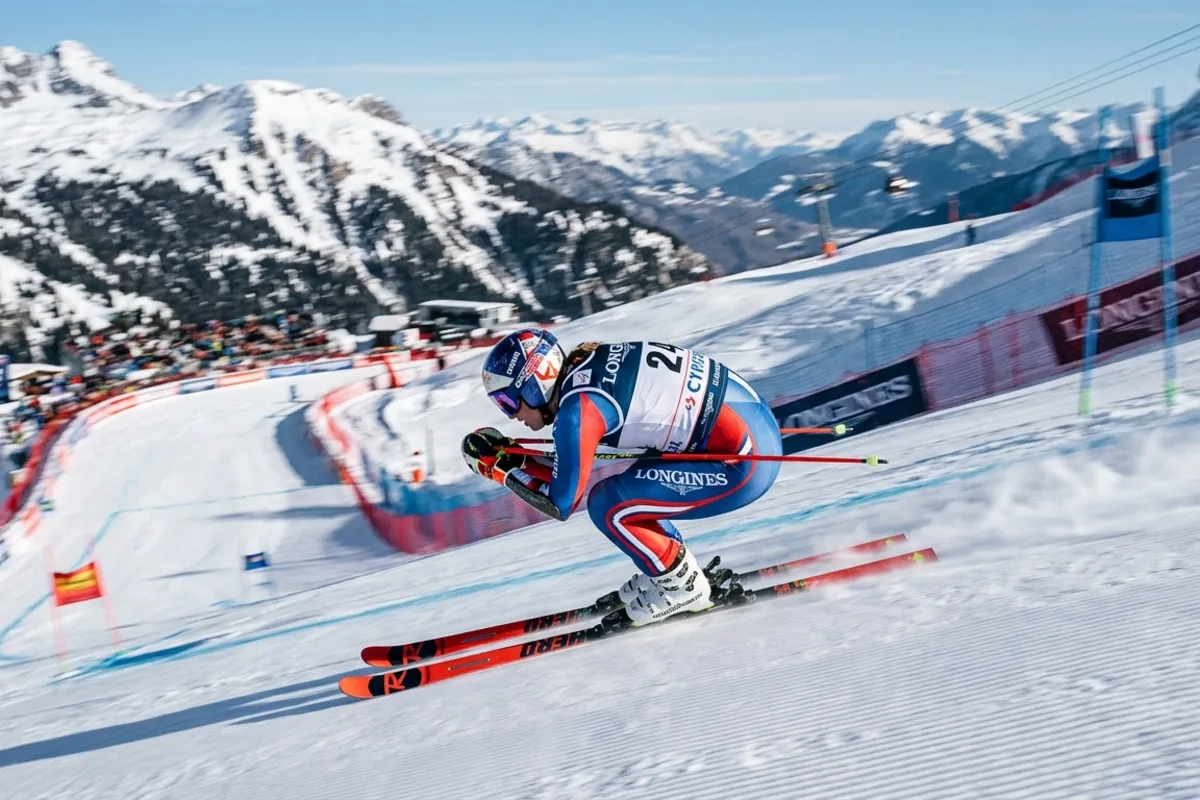
Generating and maintaining speed is the central challenge in the alpine disciplines of downhill and Super-G. Unlike the technical events of Slalom and Giant Slalom, where rhythm and agility are paramount, the speed events demand a unique combination of raw courage, aerodynamic efficiency, and an almost intuitive understanding of physics.
An athlete can possess flawless technique, but without a deep comprehension of how to interact with the forces at play, gravity, friction, and air resistance, they will consistently lose tenths, and even full seconds, on the course. This is not about simply pointing the skis downhill; it is about a calculated, systematic process of minimizing resistance and maximizing acceleration at every possible opportunity.
From the moment you push out of the start gate to the final compression before the finish line, every movement, every adjustment, and every tactical decision is a direct input into the equation of your final time.
Developing proficiency in these disciplines requires a long-term commitment that extends far beyond the race course itself. It involves a sophisticated training regimen that addresses physical conditioning, mental preparedness, and an exhaustive analysis of equipment.
Many aspiring racers underestimate the sheer volume of work required. They see the fluid grace of a World Cup athlete arcing through a high-speed turn and assume it’s a matter of talent alone.
The reality is that this apparent effortlessness is the product of thousands of hours of focused practice, countless runs dedicated to refining a single aspect of their technique, and a meticulous approach to every variable.
Here, we will analyze the core components of building a foundation for speed, moving from the fundamental principles of aerodynamics to the complex strategies of course inspection and mental execution. This is the framework that transforms a technically sound skier into a formidable speed competitor.
Content
The foundational elements of speed generation and maintenance
Before an athlete can even consider the tactical nuances of a Super-G or Downhill course, they must internalize the physical principles that govern their velocity. These are the non-negotiable fundamentals.
Without a solid base in aerodynamics, edge control at high velocity, and the ability to absorb terrain, no amount of tactical planning will be effective. This section breaks down the core physical skills that every speed event specialist must cultivate.
Aerodynamics and the science of the tuck
At the velocities reached in speed events—often exceeding 130 km/h (around 80 mph)—air resistance becomes the single greatest force working against the skier. Approximately 90% of a racer’s energy is spent overcoming this drag. Therefore, minimizing one’s aerodynamic profile is not a minor detail; it is a primary determinant of success.
The iconic downhill tuck position is the most visible manifestation of this principle. However, a truly effective tuck is far more than just crouching down. It’s a dynamic, adaptable position that must be maintained through compressions, overrolls, and during subtle changes in direction.
The ideal tuck involves creating the smallest possible frontal area. This means keeping the back flat and parallel to the skis, arms pressed against the body with hands held in front of the face to form a “cone,” and the head down with eyes looking forward.
Every detail matters: the gap between the arms and the torso, the height of the hips, and even the angle of the helmet can add or subtract precious hundredths of a second. We often use video analysis to show athletes exactly how small adjustments, like closing the space under their chin, can streamline their profile. Training for this involves more than just holding the position on a static course.
It requires drills that challenge balance and core stability while in the tuck, such as skiing over varied terrain or performing one-legged tucks on gentle slopes. The goal is to make the position so ingrained that it becomes a natural, stable platform from which to execute the rest of the race plan.
Edge interaction and pressure control at high velocity
While the tuck is for straightaways and gliding sections, the ability to carve clean, powerful turns at speed is what separates the good from the great. The physics of a high-speed turn are fundamentally different from those in a GS or Slalom course.
The G-forces are immense, and the margin for error is razor-thin. The objective is to complete the turn with the minimum possible loss of speed. This is achieved by maintaining continuous, progressive pressure on the outside ski throughout the arc of the turn.
A common mistake among developing racers is to initiate a high-speed turn too abruptly, causing the skis to skid or chatter. This scrubs speed and compromises stability. Instead, the initiation must be a fluid, patient movement, starting from the ankles and knees and gradually rolling the skis onto their edges.
The skier must actively manage pressure, increasing it as they move through the apex of the turn and then smoothly releasing it as they exit and transition to the next gate. This requires tremendous leg strength and fine motor control. We use specific drills, like long, open-radius arcs on a groomed slope, to help athletes feel this connection and build the strength to sustain it.
The focus is on a quiet upper body, allowing the legs to do the work of absorbing pressure and directing the skis. The sensation should be one of the skis “bending” around the turn, not being forced.
Terrain absorption and maintaining ski-snow contact
A Downhill or Super-G course is never perfectly smooth. It is a dynamic surface of rolls, compressions, and subtle variations that can launch a skier into the air or buckle their knees if not managed correctly. Every moment the skis are not in contact with the snow, the racer is not accelerating.
Worse, an uncontrolled landing can disrupt balance and ruin the setup for the next turn. Therefore, active terrain absorption is a vital skill. This is the ability to use the ankles, knees, and hips as a suspension system to keep the skis glued to the snow.
When approaching a compression, the athlete must anticipate the force and actively retract their legs, pulling their knees towards their chest to absorb the impact. Conversely, when going over a roll or crest, they must extend their legs to push the skis down and maintain contact with the receding snow surface.
This “pre-jumping” or “sucking up” of terrain is a proactive, not reactive, movement. It requires excellent core strength and the ability to read the terrain far ahead. We train this on varied terrain, sometimes setting simple courses over natural rolls and gullies to force athletes to constantly adjust their vertical position. The goal is to develop an instinct for maintaining a consistent level of pressure on the skis, regardless of what the ground is doing underneath them.
Advanced strategies for course management and tactical execution
Once the foundational physical skills are in place, the focus shifts to the intellectual and strategic side of speed racing. A race is won or lost not just by how well you ski, but by where you ski. Course inspection, line selection, and the ability to adapt to changing conditions are what elevate a racer’s performance. This is the chess match of speed skiing, where planning and foresight are just as important as physical execution.
The art of inspection: Reading and memorizing the line
The single inspection run is arguably the most important part of a speed event race day. Unlike in technical events where you get two runs and can make adjustments, in Downhill and Super-G, you have one chance to get it right.

During inspection, you are not just looking at the gates; you are building a three-dimensional map of the course in your mind. This involves identifying the optimal line but also noting subtle but critical details.
An effective inspection process includes:
- Identifying the fall line: Understanding the natural path of gravity down the slope is the starting point for any line choice. The fastest line is often the one that stays closest to the fall line for the longest duration.
- Analyzing turn shape and radius: Is a turn a long, sweeping arc or a tighter, more abrupt change of direction? This determines how early you need to initiate the turn and how much pressure you can carry through it.
- Locating key features: You must pinpoint every compression, roll, side-hill, and blind gate. For each one, you need a plan. Where will you apply pressure? Where will you absorb? Where is the ideal spot to be airborne, and more importantly, where will you land?
- Assessing snow conditions: Is the snow icy and aggressive, or soft and forgiving? Are there shady sections that might be slicker? These factors will influence how much edge angle you can use and how hard you can push the line.
A common practice among elite athletes is to “slip” the course multiple times, each time focusing on a different aspect. The first slip might be for the general line, the second for terrain features, and a third for specific gate sequences.
After slipping, visualization is the next step. You must be able to run the entire course in your head, from start to finish, feeling every turn and every terrain feature. This mental rehearsal solidifies the plan and builds the confidence needed to execute it at full speed.
Line choice and risk management in Super-G
Super-G, or Super Giant Slalom, presents a unique tactical challenge because it blends the high speeds of Downhill with the more frequent turning of Giant Slalom. The gates are closer together than in Downhill, forcing the racer to make more decisions at a faster rate.
The Super G training methodology we employ emphasizes adaptability and strategic thinking. The core dilemma in Super-G is constantly balancing a direct, “high” line with the need to complete the turn and set up for the next gate.
A “high line” means starting the turn closer to the outside of the course, which allows the racer to complete the turn above the gate. This sets them up with a better angle for the subsequent gate and allows them to generate more speed by skiing a straighter path downwards.
The risk is that if you are too high or too late with your turn initiation, you may miss the gate entirely. A “low line,” or “round line,” is safer, as you give yourself more room, but it involves more skiing across the hill, which scrubs speed. The best Super-G racers are masters of finding the highest, most direct line that is still realistically achievable.
This requires an almost sixth sense for speed and timing, developed through extensive practice with a high-speed gate volume in training. We set courses that specifically challenge this decision-making process, forcing athletes to choose between a risky direct line and a safer, rounder one and then analyzing the time differences with video.
Adapting to changing light and course conditions
No two runs are ever identical. The conditions on race day can change dramatically from the first forerunner to the last racer. The sun moving across the sky can change flat light into high contrast or vice versa.
The track can become icier and faster as more racers go down it, or it can rut up and become slower. The ability to adapt to these changes in real-time is a hallmark of a mature racer.
During inspection, it’s important to consider how the course might evolve. If you have a later start number, you might look for alternate lines that could be faster once a groove has been worn into the main line. You also need to be mentally prepared for flat light, which can make it incredibly difficult to see subtle terrain variations.
In these conditions, you must rely more on the feeling through your feet and your memorization from inspection. We often train in less-than-ideal conditions for this very reason. Skiing a course in a snowstorm or in flat light builds resilience and teaches athletes to trust their instincts when their vision is compromised. This adaptability is not just a physical skill; it is a mental one. It’s about accepting that conditions will not be perfect and having the confidence to execute your plan regardless.
The role of physical conditioning and equipment preparation
The demands of speed events on the human body and its equipment are extraordinary. The G-forces experienced in a turn can be more than three times the force of gravity, and a race can last for over two minutes, requiring sustained muscular endurance and intense focus.
Similarly, the skis, boots, and bindings are subjected to immense stress. A holistic approach to alpine ski racer speed events training must therefore include a rigorous off-snow conditioning program and a meticulous equipment preparation routine.
Building a power-endurance engine for speed
The physical profile of a speed skier is different from that of a slalom specialist. While both require explosive power, the speed athlete needs a much greater capacity for muscular endurance. They must be able to hold a powerful tuck for extended periods and absorb massive forces in turns, repeatedly, for the entire duration of the course. The conditioning program must reflect these demands.
Key components of a speed skier’s physical training include:
- Eccentric strength: This is the strength used to absorb force, for example, when landing a jump or entering a compression. Exercises like deep squats with a slow, controlled descent and plyometrics like depth jumps are excellent for developing this.
- Isometric strength: This is the ability to hold a static position under load, which is precisely what the downhill tuck position requires. Wall sits, planks, and holding a squat position for extended periods are fundamental exercises.
- Core stability: A strong and stable core is the link between the upper and lower body. It allows the legs to move independently to absorb terrain while the upper body remains quiet and aerodynamic. A wide variety of exercises, from rotational medicine ball throws to anti-rotation presses, are used to build a robust core.
- Power endurance: This is the ability to produce powerful movements repeatedly without fatiguing. Circuit training that combines strength exercises (like squats or lunges) with explosive movements (like box jumps) and short cardiovascular bursts is an effective way to train this quality.
The annual training plan is periodized, with a focus on building a strength base in the off-season, converting it to power in the pre-season, and maintaining it during the competitive season. This structured approach ensures the athlete arrives at the start gate physically prepared for the unique challenges of the course.
The meticulous science of ski and boot tuning
In a sport decided by hundredths of a second, equipment can be the difference between the podium and fifth place. For speed events, this is especially true. The preparation of the skis is a science in itself. The goal is to make the ski base as fast as possible and the edges as sharp and precise as possible.
The process starts with the ski’s structure. The base of the ski is ground with a specific pattern, or “structure,” designed to channel water away from under the ski, reducing friction. The choice of structure depends on the snow temperature and humidity. Then comes waxing.
A professional speed skier might have dozens of different waxes, each formulated for a specific snow condition. The process involves applying multiple layers, from base layers to harder waxes for durability, and finally a topcoat of a high-fluorocarbon wax or powder for maximum glide. This is a time-consuming, precise process that requires expertise and experience.
The edges are equally important. They must be perfectly sharp to hold on icy surfaces but also beveled at a precise angle. The base edge bevel (typically 0.5 to 1 degree) lifts the edge slightly off the snow when the ski is flat, preventing it from feeling “grabby.” The side edge angle (typically 87 or 88 degrees) determines how aggressively the ski will bite into the snow during a turn.
Finding the right combination of angles for a specific athlete and condition is a key part of the tuning process. Boots are also a critical component. They must be stiff enough to transmit force to the skis but have enough flex to allow the athlete to absorb terrain. Many racers have their boots custom-fitted, with the shell and liner modified to match the exact shape of their foot and lower leg.
Integrating mental skills for high-stakes performance
The mental aspect of speed skiing cannot be overstated. Standing in the start gate at the top of a course like the Lauberhorn in Wengen, knowing you are about to travel at speeds that would be illegal on a highway, requires a unique mental fortitude. Fear is a natural and even necessary emotion; it keeps you sharp. The key is to manage it, not let it manage you. A robust mental skills program is an integral part of elite preparation.
| Mental Skill | Objective | Training technique |
| Visualization | To mentally rehearse the perfect run, building neural pathways and confidence. | Daily practice of running the course in one’s mind, in real-time, from a first-person perspective. This is done after course inspection and before sleep. |
| Arousal Control | To manage anxiety and nervousness, finding the optimal level of activation for performance. | Breathing techniques, such as box breathing (inhale for 4s, hold for 4s, exhale for 4s, hold for 4s), to calm the nervous system in the start gate. |
| Focus and Concentration | To maintain attention on the task at hand and block out external and internal distractions. | Using cue words or “trigger phrases” (e.g., “smooth,” “forward,” and “attack”) to bring focus back to the present moment during the run. |
| Confidence Building | To develop a resilient belief in one’s ability to execute the race plan under pressure. | Reviewing past successes, focusing on process goals (e.g., “nail the transition into the flat”) rather than outcome goals (e.g., “win the race”), and positive self-talk. |
These skills are not learned overnight. They are developed through consistent practice, just like any physical skill. We integrate mental coaching into our training camps, teaching athletes these techniques and helping them create a personalized pre-race routine. This routine becomes a source of comfort and consistency, allowing them to step into the start gate feeling prepared, focused, and in control.
Putting it all together: The training and development pathway
Becoming a proficient speed skier is a long-term project. It requires a progressive, structured pathway that builds skills systematically over several years. Rushing this process is not only ineffective but can also be dangerous. The training must evolve as the athlete matures, both physically and mentally, introducing new challenges at the appropriate time.
From Giant Slalom fundamentals to Super-G introduction
The foundation for all speed skiing is a strong background in Giant Slalom (GS). GS is the bridge between the technical and speed events. It teaches the fundamental carving skills, pressure control, and line management that are essential for Super-G and Downhill, but at more manageable speeds.
A young racer should spend several seasons developing a high level of proficiency in GS before seriously specializing in speed.
The transition to speed typically begins with an introduction to Super-G. Initially, this is done in a controlled environment. We start with “speed elements” training, where we set sections of a Super-G course on a safe, open slope. This allows athletes to get a feel for the higher speeds and longer skis without the intimidation of a full-length course.
The focus is on fundamental body position, maintaining the tuck, and learning to manage the longer turn radii. This gradual introduction builds confidence and ensures that the core techniques are sound before moving on to more complex challenges.
Progressive exposure to speed and terrain
As athletes become more comfortable, the training progresses. The courses become longer, the terrain more varied, and small jumps and rolls are introduced. This is a critical phase where the skill of terrain absorption, which we discussed earlier, is developed.
The goal is to make the athlete comfortable and proactive when dealing with terrain, rather than reactive and defensive. Safety is the priority throughout this process. Courses are set with ample runoff room, and coaches are positioned at key sections to provide feedback and ensure a secure training environment.
Our year-round training opportunities, from the glaciers of Zermatt and Saas-Fee in the summer to our winter programs, allow for this kind of consistent, progressive development. The high-altitude glaciers provide an ideal setting for this phase, offering long, rolling slopes where we can set appropriate challenges. The volume of training is important.
An athlete needs to spend a significant amount of time on long skis to develop the specific feeling and balance required for speed events. This is where a structured program provides a significant advantage over sporadic training.
The importance of structured camp environments
Training camps provide an immersive environment that is highly conducive to rapid learning. Being surrounded by peers with similar goals and receiving daily feedback from a team of experienced coaches creates a powerful developmental synergy.
At Ski Zenit, our camps are designed to be comprehensive training experiences. A typical day might involve on-snow sessions in the morning focused on specific technical or tactical goals, followed by video analysis in the afternoon where athletes can see themselves and compare their skiing to expert demonstrations. This is often supplemented with physical conditioning sessions, equipment tuning workshops, and mental skills training.
This structured environment removes the logistical burdens from the athlete, allowing them to focus entirely on their development. It also provides access to a level of expertise and various training environments that would be difficult for an individual to replicate.
For adult racers, such as those in Masters programs, these camps offer a chance to receive elite-level coaching in a flexible format that fits into their lives. The focused, intensive nature of a camp can lead to breakthroughs in technique and understanding that might take an entire season to achieve otherwise.
Are you ready to commit to a structured path for improving your competitive skiing? Whether you are looking to refine your race technique, understand the complexities of gate strategy, or benefit from professional guidance on equipment choices that can give you an edge, a dedicated program is your next step.
Join one of our competitive skiing camps to access the focused training and expert advice that will help you achieve your goals on the race course.