
Every competitive ski racer eventually hits a plateau. You’ve refined your line, your tuck is tight, and your equipment is dialed in, yet the clock tells a frustratingly familiar story. The fractional seconds that separate the podium from the pack feel impossibly out of reach.
The answer, however, may not be found on the snow, but in the gym. The key to shattering that speed barrier lies in developing a quality that traditional strength training often overlooks: explosive power.
This isn’t about simply being strong; it’s about being fast. It’s the ability to generate maximum force in the minimum amount of time, a physical attribute that is the very essence of high-level alpine skiing.
From the instant you explode out of the start gate to the powerful, dynamic transitions between turns, ski racing is a sequence of explosive movements. Each turn is a rapid cycle of eccentric loading (absorbing force as you enter the turn) and a concentric explosion (driving power to accelerate out of it).
The faster and more powerfully you can execute this cycle, the more speed you can generate and maintain down the course. This is where a targeted approach to off-snow conditioning becomes a non-negotiable component of a serious racer’s preparation.
By focusing on movements that train your neuromuscular system to fire more rapidly and efficiently, you are directly programming your body for the unique demands of the racecourse.
This guide will delve into the science and application of this training philosophy, providing the tools you need to build the powerful, reactive engine that drives elite-level speed.
Content
Understanding the engine of speed: The science of power in skiing
To truly improve, it’s essential to understand the “why” behind the training. Simply going through the motions in the gym won’t produce the desired results on the hill. We need to connect the dots between a specific physical quality and its direct application to carving a faster turn.
Speed in skiing is a direct result of how effectively a racer can manage and generate forces against the snow. This interaction is governed by physics, but it’s unlocked by physiology.
The biomechanics of a high-speed turn
Think about what happens in a single giant slalom or slalom turn. As you initiate the turn, your body and skis are subjected to immense gravitational and centrifugal forces. Your muscles, particularly in the legs and core, must work eccentrically to absorb this load, coiling like a spring.
The critical moment—the one that separates good from great—is the transition. This is where that stored energy must be released in a powerful, concentric contraction. You are not just guiding the skis into the new turn; you are actively driving and accelerating through the apex and into the fall line.
The faster you can make this transition, the quicker you can get your skis on their new edge, and the more acceleration you can produce. A merely strong skier can resist the forces, but a powerful skier can absorb them and instantly convert them into speed.
This requires a highly tuned nervous system that can recruit muscle fibers instantly. It’s less about the total weight you can squat and more about how quickly you can generate force out of the bottom of that squat. This is the foundation of explosive power.
Beyond strength: Introducing power and neuromuscular efficiency
In the world of athletic performance, strength and power are often used interchangeably, but they are distinctly different. Strength is the ability to exert force. Power is the ability to exert force quickly. The formula is simple: Power = Force x Velocity.
You can increase power by increasing force (getting stronger) or by increasing the velocity at which you apply that force (getting faster). Elite ski racers need both, but the velocity component is frequently the missing link in an athlete’s training program.
This is where the concept of neuromuscular efficiency becomes paramount. Your brain communicates with your muscles via the central nervous system. The more efficient this pathway is, the faster and more forcefully your muscles can contract. Explosive training is, in essence, training for your nervous system.
It teaches your body to recruit more motor units (the combination of a nerve and the muscle fibers it controls) and to fire them in a more synchronized and rapid fashion.
This enhanced efficiency is what allows you to make lightning-fast adjustments on an icy course or power out of a compression with speed rather than just surviving it. It’s about building a responsive, reactive body that can execute movements with both strength and incredible speed.
How explosive movements translate directly to the snow
Every drill performed in the gym should have a clear and direct purpose for on-snow performance. The connection between explosive training and skiing is remarkably direct. A box jump, for instance, mimics the powerful leg extension required to accelerate out of a turn. A rotational medicine ball throw develops the core power needed to maintain a strong upper-lower body separation and drive the skis across the fall line.
This type of training enhances what is known as the stretch-shortening cycle (SSC). The SSC is the ‘spring-like’ action of your muscles and tendons—the rapid eccentric loading followed by an immediate concentric explosion. A well-developed SSC is what allows you to feel “light” and “poppy” on your skis.
It enables you to absorb terrain variations and compressions without losing speed and to actively use those forces to propel yourself forward. When you see a World Cup racer effortlessly bounce through a difficult combination, you are witnessing a perfectly executed SSC, a skill honed through countless hours of dedicated, explosive ski training.
Building the foundation: Essential plyometric drills for racers
Now that we understand the ‘why,’ we can focus on the ‘how.’ Plyometrics are the cornerstone of developing explosive power. These drills use the stretch-shortening cycle to increase the speed and force of muscular contractions.
They are demanding and require perfect form, but their payoff in terms of ski racing performance is immense. The goal is always quality over quantity. Each repetition should be performed with maximum intent and perfect technique.
The core mechanic: The stretch-shortening cycle in action
Before jumping into the exercises, it’s crucial to grasp the feeling of the stretch-shortening cycle. The simplest example is a vertical jump. When you dip down quickly before jumping up, you are eccentrically loading your glutes, hamstrings, and quads. Your muscles and tendons store this energy like a stretched rubber band.
The immediate and powerful upward jump is the concentric release of that stored energy. The key to effective plyometrics is minimizing the time between the stretch and the shortening. This transition phase, known as the amortization phase, needs to be as short as possible.
A long, slow dip before a jump negates the plyometric effect. It becomes a simple strength exercise. A short, sharp, and reactive movement is what trains the nervous system to become more efficient. When performing any of the following drills, focus on being quick off the ground.
The ground is a springboard, not a rest stop. This principle of minimizing ground contact time is what builds the reactive ability that is so critical for a ski racer who needs to move from edge to edge in a fraction of a second.
Foundational lower-body plyometrics: Your power source
The legs are the engine of a ski racer. Developing their explosive capacity is the number one priority. These exercises form the bedrock of a solid plyometric program. Always start with the basics to build a proper foundation of technique and landing mechanics before progressing to more advanced variations.
Here is a list of fundamental lower-body plyometric exercises:
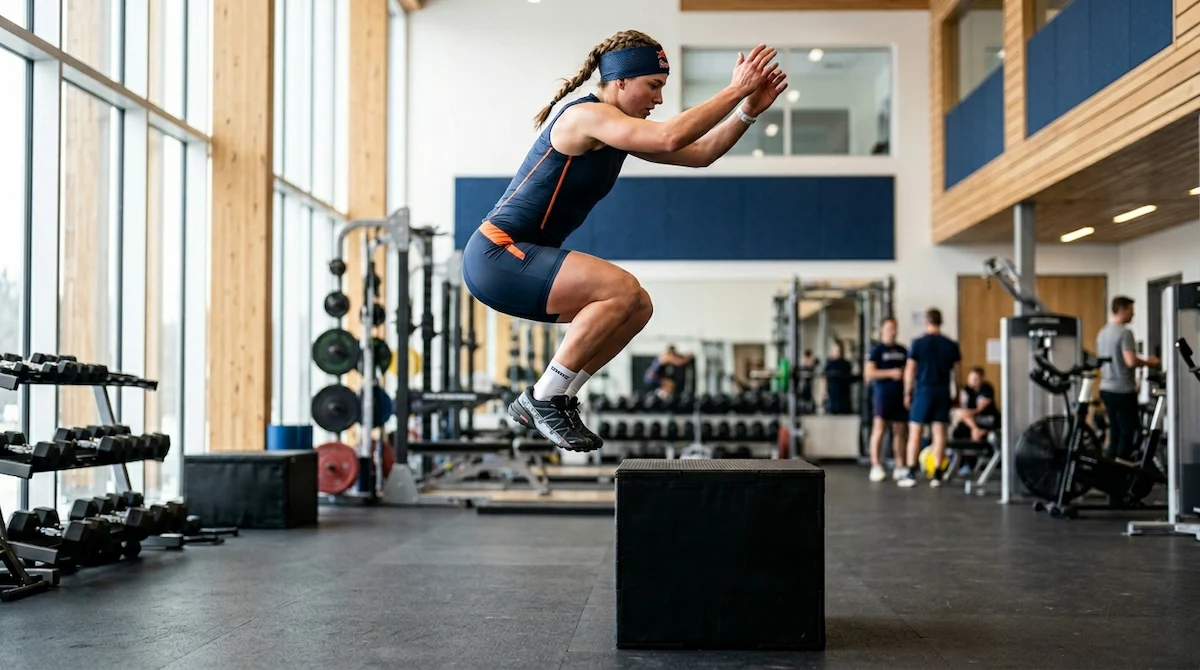
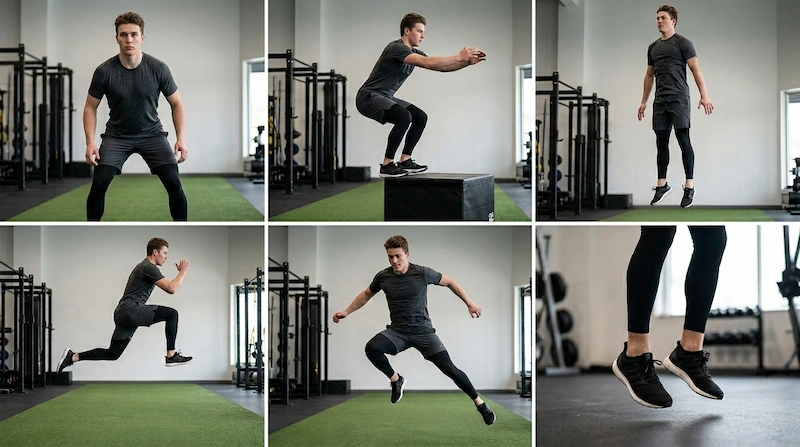
- Box jumps: This is a classic power development exercise. Stand in front of a sturdy box or platform. Dip at the hips and knees, swing your arms back, then explode upwards, driving your arms forward and landing softly on the center of the box. The focus is on the explosive upward movement. Step down, don’t jump down, to protect your joints. Progression involves increasing the box height, but only when you can do so without sacrificing landing form. Your landing should be quiet and stable, with your knees aligned over your feet.
- Squat jumps: Begin in an athletic stance, feet shoulder-width apart. Lower yourself into a quarter-squat position and immediately explode vertically, jumping as high as possible. Land softly, absorbing the impact by bending your knees and hips, ready for the next jump. The key is to make the movement continuous and reactive. Focus on minimizing the time you spend on the ground between jumps.
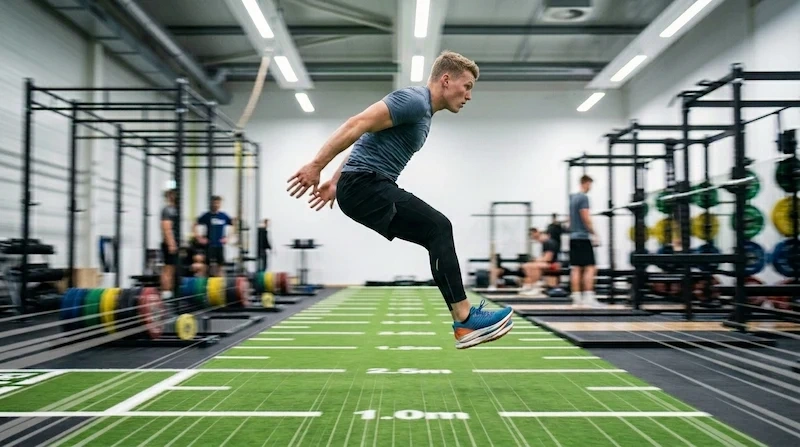
- Broad jumps: This exercise develops horizontal power, crucial for movements like skating out of the start gate or driving across the hill. From a standing position, dip and swing your arms, then explode forward, jumping as far as you can. Land in a stable squat position and hold the landing for a second or two to demonstrate control before resetting for the next repetition.
- Lateral bounds: Skiing is a lateral sport. Lateral bounds directly train the muscles responsible for moving from side to side and for stabilizing the hip on the outside ski. Stand on your right leg. Dip slightly and explode laterally, jumping to your left. Land softly on your left leg, absorbing the force and stabilizing your body before immediately bounding back to the right. The goal is to cover as much distance as possible while maintaining balance and control on each landing.
- Ankle hops (pogo jumps): This drill focuses on stiffness and reactivity in the ankle joint, which is vital for quick edge changes. Keeping your legs relatively straight (a slight bend in the knee is okay), jump up and down using primarily your calf and ankle muscles. The goal is to be as springy as possible, spending minimal time on the ground. Think of your feet as bouncing off a hot surface.
Integrating the upper body and core for complete power
While the legs provide the primary power, a strong and explosive upper body and core are essential for transferring that power through the body and into the skis. The core acts as the link between the lower and upper body, and a weak core will lead to a significant “power leak.” A powerful pole plant can also be a source of acceleration, particularly in slalom.
- Medicine ball slams: This is a fantastic exercise for developing total body power and core strength. Hold a medicine ball overhead, rise up onto your toes, and then use your entire body—lats, abs, and hips—to slam the ball into the ground directly in front of you as hard as possible. Catch the ball on the bounce and immediately go into the next repetition. This teaches you to channel force from your upper body through your core.
- Rotational medicine ball throws: The rotational power developed here is directly applicable to the cross-body tension and rotational forces experienced in a ski turn. Stand perpendicular to a solid wall. Hold the medicine ball at your hip furthest from the wall. In one fluid, explosive motion, rotate your hips and torso and throw the ball against the wall as hard as you can. Catch it and repeat. This builds power in the obliques and hips, which are critical for maintaining a stable upper body while the legs are carving beneath you.
- Plyometric push-ups (clap push-ups): For developing upper body pushing power, plyometric push-ups are excellent. Lower yourself into a standard push-up position. Then, explosively push up with enough force that your hands leave the ground. For an added challenge, perform a clap mid-air before landing softly and immediately descending into the next rep. This builds the explosive strength needed for powerful and effective pole plants.
Structuring your training for peak performance on race day
Performing random exercises is not a plan. To achieve real, measurable gains, your explosive training must be integrated into a well-thought-out, periodized annual plan. The type, volume, and intensity of your plyometric work should change depending on the time of year and your proximity to the competitive season. The goal is to build power in the off-season and then maintain it while peaking for key races.
Periodization: The when and why of explosive training
A training year is typically broken down into several phases: the off-season (preparation phase), the pre-season (pre-competition phase), and the in-season (competition phase). Your plyometric training should adapt to each phase.
- Off-season (May-August): This is your primary window for building your physical base. The focus here is on developing foundational strength first, then transitioning to power. Early in the off-season, you’ll introduce low-intensity plyometrics (like squat jumps and ankle hops) to build technique and tissue tolerance. As the off-season progresses, the intensity and complexity of the drills increase. This is where you’ll incorporate higher box jumps and more aggressive bounding exercises. The volume of plyometrics is highest during this phase.
- Pre-season (September – November): As you begin to get back on snow, the goal of your dryland training shifts. You are no longer trying to build maximal power but rather convert your newfound power into ski-specific strength and endurance. The volume of plyometrics will decrease, but the intensity remains high. The exercises become more specific to skiing movements. This is a great time to incorporate complex training—pairing a heavy strength exercise (like a squat) with a biomechanically similar plyometric exercise (like a box jump) to maximize power output.
- In-season (December-April): During the race season, the primary goal is performance and recovery, not building new physical qualities. Dryland training becomes about maintenance. The volume of plyometrics should be low—typically one short, high-intensity session per week is sufficient. The purpose of this session is to keep the nervous system firing efficiently. Overtraining during this phase can lead to fatigue and an increased risk of injury. The focus should be on sharp, crisp movements that leave you feeling energized, not exhausted.
Sample workouts and progression models
Progression is key to avoiding plateaus and continuing to make gains. You can progress your plyometric training in several ways: increasing the intensity (e.g., jumping higher), decreasing ground contact time, or moving to more complex, single-leg variations. It’s crucial to master the double-leg versions of exercises before attempting single-leg versions to ensure you have the requisite stability and strength.
Here is a sample progression for a mid-off-season workout:
- Warm-up (10-15 minutes): Start with light cardio (jogging, cycling) followed by dynamic stretching (leg swings, arm circles) and activation drills (glute bridges, bird-dogs). Finish with some low-intensity “primer” jumps like pogo hops.
- Main set (Focus on quality):
- A1: Box Jumps – 4 sets of 5 repetitions. Focus on maximum height and a soft landing. Rest 90 seconds between sets.
- B1: Lateral Bounds – 3 sets of 6 repetitions per side. Focus on distance and control on the landing. Rest 90 seconds.
- C1: Rotational Medicine Ball Throws – 3 sets of 8 repetitions per side. Focus on explosive rotation. Rest 60 seconds.
- D1: Plyometric Push-ups – 3 sets of 5-8 repetitions (or to technical failure). Focus on explosive push. Rest 60 seconds.
- Cool-down (5-10 minutes): Finish with static stretching for the major muscle groups worked, such as quads, hamstrings, glutes, and chest.
This is a general template. An athlete’s specific program should be tailored to their age, experience level, and individual strengths and weaknesses. A younger athlete might focus more on technique and lower-intensity drills, while a seasoned professional will incorporate more advanced and high-impact movements.
Safety first: Technique and injury prevention
Plyometrics are high-impact and place significant stress on the joints, muscles, and connective tissues. Therefore, safety and perfect technique are non-negotiable. Rushing into advanced drills without the proper foundation is a recipe for injury.
Always remember these key safety principles. First, you must have an adequate strength base. An athlete should generally be able to squat 1.5 times their body weight before engaging in high-intensity plyometrics. Second, always perform these drills on a suitable surface, like a gym floor with some give, grass, or turf. Avoid concrete.
Third, landing mechanics are critical. You should always land softly, in a balanced athletic position, with your knees tracking over your toes. A loud, stomping landing is a sign of poor force absorption and should be corrected immediately. Finally, listen to your body.
Plyometrics are taxing on the central nervous system. If you are feeling overly fatigued or sore, it is better to take an extra rest day than to push through and risk injury. Quality repetitions on a fresh body are infinitely more valuable than sloppy reps when you’re tired.
Advanced concepts for maximizing on-snow speed
Once you’ve mastered the fundamentals and built a solid base of explosive power, you can begin to explore more advanced training methodologies. These techniques are designed to further enhance your power output and ensure that the gains you make in the gym translate as effectively as possible to the unique demands of the ski hill. This is where you fine-tune the engine for maximum performance.
Combining strength and plyometrics for peak power
One of the most effective advanced techniques is known as complex training or contrast training. This involves pairing a heavy strength exercise with a biomechanically similar plyometric exercise. For example, performing a heavy set of back squats followed immediately by a set of box jumps. The theory behind this is called post-activation potentiation (PAP).
The heavy lift excites the nervous system and recruits a large number of high-threshold muscle fibers. This “potentiated” state allows you to perform the subsequent plyometric movement with greater power and speed than you would have otherwise.
This method is incredibly effective but also very demanding. It should only be used by experienced athletes with a solid training history. A sample complex pair for a ski racer could be:
- Heavy barbell hip thrusts (3-5 reps) followed immediately by broad jumps (5 reps). This pairing develops the powerful hip extension that is crucial for driving out of the turn.
- Heavy Goblet Squats (3-5 reps) followed immediately by Squat Jumps (6 reps). This focuses on vertical power development.
These complexes should be performed during the pre-season phase to sharpen the nervous system and peak your power output just as you are returning to the snow. The rest periods between the complex pairs should be long (3-5 minutes) to allow for full recovery and maximum quality on each set.
Measuring progress: Are you actually getting faster?
“What gets measured, gets managed.” It’s important to track your progress to ensure your training is effective and to maintain motivation. While the ultimate test is the stopwatch on the racecourse, there are several objective gym-based tests you can use to monitor your explosive power development.
- Vertical jump test: This is the gold standard for measuring lower-body vertical power. Using a Vertec device, jump-mat, or simply marking your reach on a wall, you can get a reliable measure of your progress. Test this every 4-6 weeks to see how your training is impacting your explosive ability.
- Broad jump test: This measures horizontal power. From a standstill, perform a maximum-effort two-footed jump for distance. Measure from the starting line to the back of your heels.
- Timed sprints: Short sprints (10-20 meters) are a great way to measure acceleration, which is a key component of explosive power.
- On-snow feedback: Ultimately, the goal is to ski faster. Pay attention to how you feel on the snow. Do you feel more “pop” out of the turns? Can you hold a higher line with more authority? Can you accelerate through flats and compressions where you used to bog down? This qualitative feedback, combined with video analysis and timed runs, is the most important indicator of success. At our training camps, we use detailed video analysis to directly correlate an athlete’s physical improvements with tangible changes in their on-snow technique.
The mental edge of physical preparedness
The benefits of a dedicated explosive training program extend beyond the purely physical. There is a profound psychological advantage to knowing you have done the work and are physically prepared for the demands of the racecourse.
When you stand in the start gate, the confidence that comes from being stronger and more powerful than your competitors is a tangible asset. This confidence allows you to ski more aggressively, take more risks, and push your limits.
You trust your body to handle the forces and to react instantly to the unpredictable nature of the course. This reduces hesitation and allows you to ski with a fluid, attacking mindset. The physical work you do in the gym builds not just a powerful body, but also a resilient and confident mind.
This holistic preparation is what truly defines an elite athlete. The plyometric exercises for ski speed are not just about training your muscles; they are about forging the belief that you have the physical capacity to win.
Are you ready to stop hitting plateaus and start unlocking your true speed potential? A generic gym program can only take you so far. To reach the next level in competitive skiing, you need a plan that is scientifically designed, professionally coached, and completely tailored to the unique demands of the sport.