
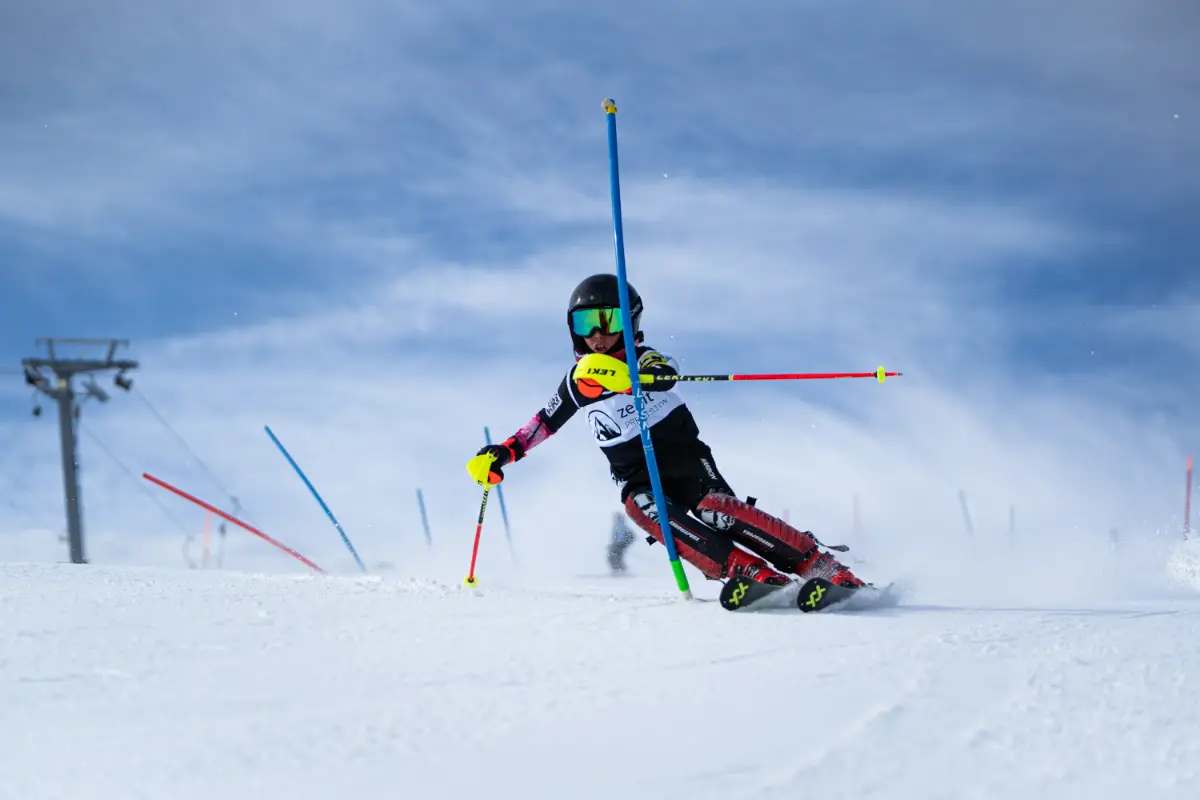
In ski racing, hundredths of a second separate the podium from the rest of the field. Every athlete at an elite level has dedicated thousands of hours to physical conditioning and refining their ski technique.
They have the best equipment, dialed-in for the conditions of the day. So, what creates that minuscule, yet decisive, gap? Often, the difference isn’t in the skis or the muscles; it’s between the ears.
The mental game in ski racing is as critical as any physical attribute. It’s the silent engine that drives performance under pressure, the compass that guides an athlete through the turbulence of a race run, and the foundation upon which consistency is built.
An athlete can have a flawless line in training but crumble in the start gate on race day. This is where a systematic approach to mental conditioning becomes a non-negotiable part of a comprehensive training plan.
Developing mental strength isn’t about simply “being tough” or ignoring pressure. It’s a trainable skill, much like perfecting a turn or building explosive power in the gym.
It involves a collection of tools and strategies that allow a racer to manage their thoughts, regulate their emotions, and maintain focus on the task at hand. From the lonely moments in the start hut to the split-second decisions required in a complex GS course, a mentally prepared athlete operates with a clarity and confidence that directly translates to faster times.
This preparation involves understanding one’s own psychological triggers, building routines that create a performance mindset, and learning to rebound from the inevitable setbacks that are part of any competitive career. It’s about building a psychological framework that supports, rather than sabotages, physical talent.
Our approach to coaching has always been holistic, recognizing that the athlete is not just a body to be trained but a mind to be sharpened. Over years of working with racers from their first junior competitions to the world stage, we’ve seen firsthand how targeted mental training can transform potential into results.
It’s the component that helps an athlete access their best skiing when it matters most. This guide will walk through the core pillars of mental fortitude in ski racing, offering practical strategies and insights drawn from our experience on the hill.
We will look at the specific psychological demands of the sport and provide a roadmap for developing the resilience, focus, and self-belief necessary to stand on top of the podium.
Content
Establishing the foundation: awareness and goal setting
Before any specific drills can be effective, a racer must first develop a high level of self-awareness. This is the bedrock of all mental performance work. It means understanding your internal state—your thoughts, emotions, and physical sensations—without judgment.
Many racers operate on autopilot, reacting to pressure or mistakes without understanding the underlying cause. They might feel their legs get heavy in the start gate or their focus drift mid-course, but they treat these as unavoidable events rather than signals that can be managed.
The first step is to start paying attention. This process of introspection helps an athlete identify their unique patterns of thought and emotional response, particularly in high-stakes situations.
It’s about asking the right questions: What do I tell myself after a mistake? How does my body feel when I’m nervous? What thoughts precede my best performances?
This awareness is not about eliminating negative thoughts or feelings of nervousness. Nerves are a natural and often helpful part of competition; they signal that the event is important.
The goal is to recognize these feelings, understand their effect, and develop strategies to ensure they don’t derail performance. An athlete who is aware of their tendency to “over-think” a course inspection can consciously implement a strategy to simplify their focus.
An athlete who notices their heart rate spiking with anxiety before a run can use breathing techniques to regulate their physiological response. This is the difference between being a passenger to your own mental state and being the pilot.
One of the most effective tools for building this awareness is a training and competition journal. After each session, taking a few minutes to log not just what you did physically, but also what you were thinking and feeling, can reveal powerful insights over time. It transforms the abstract world of thoughts and feelings into concrete data that can be analyzed and acted upon.
Setting process-oriented goals
Once an athlete has a better understanding of their internal landscape, the next step is to direct their focus through effective goal setting. In a sport measured by time, it’s easy to become fixated on outcome goals: winning a race, making the national team, or achieving a certain FIS point profile.
While these long-term ambitions provide motivation, focusing on them exclusively during a race can be counterproductive. Outcome goals are largely outside of an athlete’s direct control; you can’t control how fast your competitors ski or if a sudden gust of wind slows you down. This lack of control can create anxiety and a sense of powerlessness.
The solution is to shift the primary focus to process-oriented goals. These are small, specific, and actionable tasks that are entirely within the athlete’s control. A process goal is not “win the race,” but rather “execute a powerful start,” “maintain a low tuck on the flats,” or “keep my hands forward through the finish.”
These goals anchor the athlete in the present moment and direct their attention to the specific actions that lead to a fast run. By concentrating on the process, the outcome often takes care of itself.
For a U16 racer struggling with inspection, a process goal might be to identify only three key sections of the course to focus on, rather than trying to memorize every single gate.
For a Masters athlete, it could be as simple as committing to a clean, early edge set at the top of each turn. These goals are measurable, achievable, and build confidence with each successful execution. They break down the enormous pressure of a race into a series of manageable steps, giving the athlete a clear plan and a sense of control.
The power of a performance journal
A performance journal is a simple yet profoundly effective tool for cultivating both self-awareness and effective goal setting. It serves as a personal laboratory where a racer can experiment with different mental approaches and track their progress.
A journal entry doesn’t need to be an essay; it can be a few structured bullet points. Here’s a practical structure that many athletes find useful:
- Session objective: What was the main technical or tactical focus of today’s training? (e.g., “Maintaining outside ski pressure through the transition.”)
- Process goals: What were my 1-2 specific, controllable goals for the session? (e.g., “1. Aggressive pole plant at the start. 2. Look ahead two gates at all times.”)
- What went well: What did I execute successfully? Be specific. (e.g., “Felt a much stronger connection with the outside ski on the steeper pitch.”)
- What to improve: Where were the challenges? What can I adjust for next time? (e.g., “My line was too low in the flush. Need to start the turn higher above the gate.”)
- Mental/Emotional state: How did I feel? Confident? Hesitant? Focused? When did these feelings arise? (e.g., “Felt distracted during the first few runs but settled in after focusing on my breathing.”)
Reviewing this journal over weeks and months provides an invaluable record of an athlete’s development. It helps identify recurring mental blocks, reinforces successful strategies, and makes the process of improvement a conscious and deliberate one.
It’s a way to have a structured conversation with yourself about your performance, moving beyond the simple frustration of a slow run to a constructive analysis of how to be better next time. This disciplined reflection is a hallmark of elite performers in any field.
Connecting goals to long-term vision
Process goals are the building blocks, but they must be constructed on the foundation of a compelling long-term vision. This vision is the “why” behind the thousands of early mornings, cold training days, and grueling gym sessions.
It’s the emotional fuel that sustains motivation through the inevitable plateaus and setbacks. This vision should be personal and deeply meaningful to the athlete.
It might be the dream of competing in a World Cup at a specific venue like Wengen or the personal satisfaction of achieving a new level of mastery in their skiing. It’s important that this vision is the athlete’s own, not one imposed by parents or coaches. When the “why” is strong, the “how” becomes easier to endure.
The role of the coach and support system is to help the athlete connect their daily process goals to this larger vision. When a young racer is struggling with a frustrating drill, reminding them how this specific skill—for instance, absorbing terrain to maintain ski-snow contact—is a critical component of the speed required to achieve their long-term dream can reframe the immediate struggle.
It turns a tedious task into a purposeful step on a larger journey. This connection creates resilience. A bad training day or a disappointing race result is no longer a catastrophe; it’s a data point on a long-term trajectory. It provides perspective and helps the athlete stay committed to the process, understanding that mastery is a marathon, not a sprint.
Developing the mental toolkit: visualization, focus, and routines
With a foundation of self-awareness and clear, process-oriented goals, the next stage is to build a toolkit of specific mental skills that can be deployed before and during competition. These are the practical techniques that allow an athlete to manage their mental state actively.
Just as a ski technician has a set of tools for waxing, filing, and structuring skis, a racer needs a set of mental tools to prepare their mind for performance.

These skills are not innate; they require consistent practice to become reliable under pressure. The training hill is the perfect environment to practice these techniques so they become second nature by the time race day arrives.
One of the most powerful tools in this kit is visualization. This is far more than just daydreaming about success. Effective visualization, or mental imagery, is a structured and multisensory process of mentally rehearsing a performance.
The brain has difficulty distinguishing between a vividly imagined experience and a real one. When an athlete visualizes a perfect run, they are firing the same neural pathways that would be used during the actual physical execution.
This strengthens the motor patterns, builds confidence, and creates a mental blueprint for success. It’s a way to get in extra “reps” without adding physical fatigue.
Elite athletes across all sports use visualization as a core part of their preparation, and ski racing, with its complex and variable environment, is particularly well-suited to its benefits.
The art and science of visualization
To be effective, visualization must be detailed and engage as many senses as possible. It’s not enough to just “see” yourself skiing the course. A powerful visualization session involves:
- Internal vs. External perspective: Practice from both a first-person perspective (seeing the course through your own eyes) and a third-person perspective (watching yourself ski as if on video). The internal view is excellent for feeling the rhythm and sensations, while the external view is useful for analyzing line and body position.
- Kinesthetic feel: This is perhaps the most important element. Feel the pressure building on the outside ski, the sensation of the edges gripping the ice, the acceleration out of the turn, and the power of your pole plant. Imagine the physical sensations of a perfectly executed run.
- Auditory cues: Hear the sound of your edges carving the snow, the rush of the wind, the sound of the gates hitting your shin guards, and the encouraging shouts of a coach.
- Emotional state: Imagine the feeling of confidence, focus, and calm you want to have in the start gate and throughout the run. Rehearse feeling composed and aggressive.
Visualization should be used for beyond-perfect runs. It’s also an incredibly effective tool for problem-solving. If there is a particularly challenging section of a course—a steep, icy pitch or a tricky combination—an athlete can mentally rehearse that section over and over, experimenting with different lines and tactics until they feel confident in their plan.
This mental practice builds a sense of preparedness and reduces the anxiety associated with difficult course elements. The best time to practice visualization is in a quiet space, perhaps the night before a race or in the minutes leading up to the start. A few minutes of focused, high-quality mental rehearsal can be as valuable as an extra run on the hill.
Controlling the controllables: focus strategies
A race run lasts, at most, a couple of minutes. Maintaining unwavering focus for that entire duration is an immense challenge. The mind is prone to distraction, whether from an internal thought (“Am I fast enough?”) or an external event (a rut in the course, a change in the light).
The ability to control one’s attentional focus is a defining characteristic of elite racers. A key concept here is the idea of “controlling the controllables.” An athlete cannot control the weather, the course set, or their competitors.
Wasting mental energy on these factors is inefficient and anxiety-provoking. Instead, the focus must be relentlessly narrowed to the things that are 100% within their control: their effort, their attitude, and their execution of the race plan.
One effective technique for maintaining this focus is the use of cue words or trigger phrases. These are simple, powerful words or short phrases that an athlete can repeat to themselves to bring their attention back to the present moment and their process goals.
For example, if an athlete’s goal is to stay forward, a cue word could be “shins.” If the goal is to be aggressive, it could be “attack.” These cues act as mental anchors. When the mind starts to wander or negative thoughts creep in, repeating the cue word can instantly reset the focus.
These cues should be practiced in training until the word itself triggers the desired physical and mental response. For example, a slalom skier might use the word “quick” to remind themselves to keep their feet moving rapidly through a flush. Over time, the word becomes a conditioned trigger for that specific action.
Building pre-performance routines
Routines are the scaffolding that supports performance under pressure. They are a sequence of actions and thoughts that an athlete performs consistently before a competition or a single race run.
The purpose of a routine is not superstition; it is to create a sense of familiarity, predictability, and control in an otherwise chaotic environment. A well-designed routine signals to the brain and body that it is time to perform, helping the athlete transition into their ideal performance state.
This is why you see athletes performing the same warm-up, listening to the same music, or going through the same series of movements in the start gate before every run.
A pre-run routine in the start gate is particularly important. This is where pressure is often at its peak. The routine should be short, precise, and incorporate both physical and mental components. It might look something like this:
- Breathing: Three deep, diaphragmatic breaths to lower heart rate and calm the nervous system.
- Visualization: A quick, 15-second mental run-through of the first few gates of the course.
- Physical activation: A few dynamic movements, like jumping or stomping feet, to activate the muscles.
- Cue word: A final, focused thought using a personal cue word (“Commit”) just before pushing out of the gate.
The specific elements of the routine are less important than its consistency. The routine should be practiced in training so that it becomes automatic. When the pressure of a big race is on, the athlete doesn’t have to think about what to do; they simply execute their routine.
This automation frees up mental bandwidth and builds a powerful sense of readiness and confidence. It provides an anchor of control in the final, critical moments before the clock starts.
Cultivating resilience: managing pressure and setbacks
Ski racing is a sport of failures. Even the best in the world DNF (Did Not Finish) or make significant mistakes far more often than they win. The ability to handle these setbacks, learn from them, and bounce back quickly is what separates a good racer from a great one.
This is resilience: the capacity to recover from difficulties and maintain performance in the face of adversity. Resilience is not about being immune to disappointment or frustration; it’s about how you respond to those feelings.
A resilient athlete views a mistake not as a personal failing but as a piece of feedback—information that can be used to improve. This mindset shift is fundamental to long-term success and enjoyment of the sport.
Pressure is an inherent part of competition. It can come from external sources, like the expectations of parents, coaches, or teammates, or from internal sources, like the athlete’s own desire to succeed.
The physiological response to pressure—increased heart rate, shallow breathing, and muscle tension—is often referred to as anxiety or “the butterflies.” Many athletes perceive this as a negative sign, a signal that they are about to fail.
However, this response is simply the body’s way of preparing for a challenge. The key is to reframe this perception. A resilient athlete learns to interpret these physical signals not as fear but as readiness.
They see the butterflies as a sign that their body is energized and ready to perform. One of the most effective mental toughness drills in skiing involves practicing this reframing during high-intensity training sessions, learning to associate the feeling of pressure with peak performance.
Breathing as an anchor
The most direct and effective way to manage the body’s physiological response to pressure is through controlled breathing. When we are anxious, our breathing becomes shallow and rapid, which can exacerbate feelings of panic and lead to muscle tension.
Deliberately slowing down the breath has a direct impact on the parasympathetic nervous system, promoting a state of calm and focus. A simple yet powerful technique is “box breathing”:
- Inhale slowly through the nose for a count of four.
- Hold the breath for a count of four.
- Exhale slowly through the mouth for a count of four.
- Hold the empty breath for a count of four.
Repeating this cycle for just a few minutes can significantly lower heart rate and reduce physical tension. Athletes can practice this technique anywhere: on the chairlift, before course inspection, or as part of their start-gate routine.
It is a portable and discreet tool that gives the athlete a direct lever of control over their physiological state. By mastering their breath, they can master their response to pressure, allowing them to ski with fluid, relaxed muscles rather than tight, restricted ones. This is a foundational skill for any high-pressure endeavor.
Developing a constructive response to mistakes
How an athlete responds in the seconds and minutes after a mistake can define the rest of their run, their day, and even their season. The natural emotional response to an error—catching an edge, getting late in a combination—is frustration or anger.
If an athlete dwells on that mistake, their focus is no longer on the next gate; it’s on the past. This almost guarantees further errors. Elite racers develop a “reset” mechanism, a mental routine to acknowledge the mistake, let it go, and immediately refocus on the task at hand.
This reset routine can be a simple physical action combined with a mental cue. For example, an athlete might tap their helmet and say the word “next” to themselves. This acts as a mental circuit breaker, interrupting the cycle of negative self-talk.
The goal is to shorten the “recovery time” from a mistake. In training, coaches can create drills that force this skill. For example, setting a course where a mistake in one section is almost guaranteed, and the focus of the drill is not on skiing that section perfectly but on how quickly the athlete can regain their rhythm and attack the next section.
This trains the brain to see mistakes as part of the process and to prioritize forward-looking focus. After the training session or race is over, there is time for analysis. But during the run, the only thing that matters is the next gate.
Learning from failure and building confidence
Confidence is not a mystical quality that some people are born with. It is a belief in one’s ability to succeed, and it is built, brick by brick, through preparation and experience. A major source of confidence comes from looking back at a body of hard, purposeful work.
Knowing that you have put in the hours in the gym and on the snow creates a deep-seated belief that you deserve to be there and are capable of performing. This is why consistent, high-quality training is itself one of the best mental preparation tools.
However, confidence is also built by how we interpret our experiences, particularly our failures. An athlete who defines a DNF as “I am a bad skier” will see their confidence erode.
An athlete who defines the same DNF as “I pushed my line too hard in the flush, and now I have information on where the limit is” will see their confidence remain intact, or even grow, because they have learned something valuable. This is the essence of a growth mindset. At Ski Zenit, we work hard to cultivate this perspective in our athletes.
We analyze video not to criticize, but to find opportunities for improvement. We celebrate aggressive skiing that leads to a mistake over timid skiing that leads to a clean but slow run.
This approach fosters an environment where athletes are not afraid to push their limits because they know that failure is a necessary and valued part of the learning process. True, resilient confidence comes from knowing you can handle setbacks and continue to move forward.
The holistic approach: integrating mind and body
The separation of mind and body is a false dichotomy, especially in a sport as physically and mentally demanding as ski racing. A holistic training program recognizes that every aspect of an athlete’s preparation is interconnected. Physical fatigue impacts mental focus.
Poor nutrition affects mood and decision-making. Lack of sleep impairs reaction time and emotional regulation. Therefore, a comprehensive plan for building mental fortitude must extend beyond the slopes and into the athlete’s overall lifestyle.
Creating an environment that supports high performance is about managing energy—physical, mental, and emotional—to ensure the athlete arrives at the start gate with all systems optimized.
This integration begins with understanding the profound impact of physical well-being on mental clarity. When an athlete is physically exhausted, their capacity for cognitive tasks like visualization, focus, and emotional control diminishes significantly. Overtraining is as much a mental risk as it is a physical one.
A well-structured training plan, like the ones we develop for our athletes, carefully balances periods of high-intensity work with adequate recovery. This recovery is not passive; it is an active part of the training process.
It includes proper sleep, nutrition, hydration, and techniques like stretching or foam rolling. We educate our racers that these are not optional add-ons; they are performance essentials.
An athlete who consistently gets eight to ten hours of sleep a night will have a greater capacity for learning and a more resilient stress response than one who regularly cuts corners on rest.
Nutrition for the brain
The food an athlete eats is literally the fuel for their brain. The brain is an energy-intensive organ, and its function is directly affected by blood sugar levels, hydration, and the availability of key nutrients. A diet high in processed foods and sugar can lead to energy spikes and crashes, which in turn can cause irritability and a loss of focus.
A balanced diet rich in complex carbohydrates, lean proteins, healthy fats, and micronutrients provides a steady supply of energy, supporting sustained concentration and a stable mood. Hydration is equally critical.
Even mild dehydration has been shown to impair cognitive function, slow reaction times, and increase the perception of effort. For a ski racer, this can be the difference between a clean run and a costly mistake.
We guide our athletes on practical nutritional strategies for race day. This includes a proper breakfast to top up glycogen stores, strategic snacking throughout the day to maintain energy levels, and a hydration plan that starts well before the race begins.
It’s about understanding food as a performance tool. For example, a small snack combining a complex carbohydrate and a protein (like an apple with nut butter) an hour before a second run can provide the sustained energy needed to finish the day strong, both physically and mentally.
This attention to detail demonstrates a professional approach to the sport and reinforces the connection between physical care and mental performance.
The importance of recovery and sleep
Sleep is arguably the most powerful performance-enhancing tool available to any athlete, and it is completely free. During sleep, the body repairs muscle tissue, consolidates memories, and processes learning.
For a ski racer, this means that the technical changes and motor patterns practiced during the day are solidified in the brain during sleep. A chronic lack of sleep leads to a cascade of negative effects: reduced cognitive function, slower reaction times, impaired judgment, and emotional instability. It makes it harder to learn new skills and harder to manage the stress of competition.
Creating a consistent sleep routine is a non-negotiable for serious athletes. This includes going to bed and waking up at roughly the same time each day, creating a dark and cool sleep environment, and avoiding screens (which emit blue light that can disrupt sleep patterns) for at least an hour before bed. We also emphasize the importance of “switching off” mentally.
It can be difficult for a competitive athlete to stop thinking about their sport, but dedicating time to other interests, hobbies, and social connections is vital for preventing burnout. This mental rest is just as important as physical rest. A well-rested athlete is a more focused, resilient, and ultimately, a faster athlete.
Comparative training methodologies
Different training philosophies place varying emphasis on the integration of mental and physical conditioning. Understanding these approaches can help an athlete or parent choose a program that aligns with their goals. Here is a comparison of a traditional model versus a more integrated, holistic model.
| Feature | Traditional training model | Integrated holistic model |
|---|---|---|
| Mental Skills | Treated as a separate, often optional, component. May be addressed only when a problem arises. | Woven into every aspect of on-snow and off-snow training. Mental skills are practiced daily. |
| Coach’s Role | Primarily focused on technical and tactical instruction. | Acts as a facilitator of overall development, discussing mindset, goals, and lifestyle with the athlete. |
| Recovery | Viewed as downtime or rest from training. | Treated as an active and essential part of the training process, including sleep, nutrition, and mental rest. |
| Success Metric | Primarily based on race results and times. | Based on process execution, personal growth, resilience, and long-term development, in addition to results. |
As the table illustrates, the integrated model fosters a more sustainable and ultimately more successful athletic journey. It develops not just fast skiers but also resilient, self-aware individuals who are equipped to handle challenges both on and off the mountain. This comprehensive approach is at the core of our philosophy, ensuring that every athlete we work with has the tools to reach their full potential.
The journey to becoming a complete ski racer is a complex one, requiring dedication to every facet of performance. The psychological component, once an afterthought, is now rightly recognized as a cornerstone of success.
Building mental fortitude through awareness, goal setting, specific mental skills, and a holistic lifestyle approach is what unlocks an athlete’s physical potential when it matters most.
These are not quick fixes but lifelong skills that require consistent, deliberate practice. Are you ready to take your competitive skiing to the next level? Join our competitive skiing program to perfect your technique, master gate strategy, or visit our competitive ski camps for professional training and advice on the equipment and mindset that will help you win.